
How to Calculate Printing Cost in the Textile and Apparel Industry?
Textile printing is the method of applying color to the fabric in particular patterns or designs. In the case of printed fabrics, color is bonded with the fiber so as to resist friction and washing. Textile printing is related to dyeing, but in the case of textile dyeing, the total fabric is uniformly covered with one color, whereas in textile printing, one or more colors are applied to the fabric in certain parts only and in sharply defined patterns. We are presenting this article on how to Calculate Printing Cost in the apparel industry.
Major Elements Printing Cost in Textile:
The major cost elements in the printing processes are listed in the following:
- Direct material = Dyes, chemicals, transfer paper, glitter, or foil paper.
- Direct labor = Operators and helpers in print production,
- Direct expense = Curing, steaming, etc. (If necessary),
- Overhead = Steam, power, salary, rent, etc.
Printing Cost Calculation Law or Formula in Textile:
The following formula is used to calculate printing cost in the textile industry.
Printing cost per kg,
D.M+ D.L+ D.E+ O.H
= ………………………………..
Total print production
Where,
- D.M means direct material cost,
- D.L means direct labor cost,
- D.E means direct expense cost,
- O.H means overhead cost.
Key Factors of Printing Cost in the Textile Industry:
There are some key factors that influence the printing cost excessively, which are pointed out below:
- Types of printing- Discharge, pigment, reactive, resist, block, etc.
- Method of printing- Machine printing: flat bed, rotary, and manual printing: table.
- Size of print design- Big, small, etc.
- Types of fabric- Open-width fabric or tubular fabric.
- Number of colors used in print.
- Chemicals and dyes used in printing.
- After printing treatment- Steaming, curing, etc.
- Machine cost, interest, depreciation, maintenance, etc.
- Production capacity of the print factory.
Printing Cost Calculation in the Apparel and Textile Sector:
Print is a very popular portion for all types of apparel, especially knit items. You will definitely receive an apparel export order from the buyer, including a print option in apparel. So, to learn printing cost calculation is mandatory for all apparel merchandisers.
The Comprehensive Guide on How to Calculate Printing Cost in the Textile Industry
Printing Cost Calculation Method in Textile:
Calculate the printing cost and printing rate per kg from the charts given below.
Chart-01:
| Parameters | Quantity |
| Fabric quantity | 600kg |
| Number of colors | 3 |
| Print paste consumption per kg of fabric | 300gm |
| Color 1 coverage | 50% |
| Color 2 coverage | 30% |
| Color 3 coverage | 20% |
Chart-02:
Printing paste recipe:
| Material | Color-01 | Color-02 | Color-03 |
| Dye | 4% | 6% | 2% |
| Chemical | 10% | 10% | 10% |
| Thickener | 86% | 84% | 88% |
| Total | 100% | 100% | 100% |
Chart-03:
| Parameters | Cost or Price |
| Dyes (For color-01) | Rs. 400 per kg |
| Dyes (For color-02) | Rs. 300 per kg |
| Dyes (For color-03) | Rs. 250 per kg |
| Chemical | Rs. 80 per kg |
| Thickener | Rs. 40 per kg |
| 1 day | 3 shift |
| Total process time | 12hours |
| No. of labors | 6 |
| Labor wages | Rs. 200 per shift |
| Curing | Rs. 8 per kg |
| Steam | Rs. 70000 per month |
| Power | Rs. 60000 per month |
| Transport | Rs. 30000 per month |
| Salary | Rs. 120000 per month |
| Other expenses | Rs. 100000 per month |
| Profit | 20% |
Solution:
The following formula has to be followed during printing cost calculation in the textile and apparel industry.
Printing cost per kg,
Direct Material cost + Direct labor cost + Direct expense cost + Overhead cost
= …………………………………………………………………………………………………………..… (1)
Total print production
Now,
Total production,
= Fabric input
= 600kg
Again,
Total production time,
= Process time
= 12hours
= (12/8) shift
= 1.5 shift
Direct Material Cost Calculation:
Total printing paste required,
= Total fabric × print paste consumption per kg of fabric
= 600× 300gm
= 180000gm
= 18kg
Again,
Printing paste required per color = Total printing paste × color coverage
So,
Printing paste needed for color-01 = 180kg× 50% = 90kg,
Printing paste needed for color-02 = 180kg× 30% = 54kg,
Printing paste needed for color-03 = 180kg× 20% = 36kg.
Material Used Per Color:
In the case of color-01 (90kg),
Dye = 90kg× 4% = 3.6kg× Rs. 400 = Rs. 1440
Chemical = 90kg× 10% = 9kg× Rs. 80 = Rs. 720
Thickener = 90kg× 86% = 86.4kg× Rs. 40 = Rs. 3456
In the case of color-02 (54kg),
Dye = 54kg× 6% = 3.24kg× Rs. 300 = Rs. 972
Chemical = 54kg× 10% = 5.40kg× Rs. 80 = Rs. 432
Thickener = 54kg× 84% = 45.36kg× Rs. 40 = Rs. 1814
In case of color-03 (36kg),
Dye = 36kg× 2% = 0.72kg× Rs. 250 = Rs. 180
Chemical = 36kg× 10% = 3.6kg× Rs. 80 = Rs. 288
Thickener = 36kg× 88% = 31.68kg× Rs. 40 = Rs. 1267
So,
Direct material cost stands at,
= (Color-01+ color-02+ color-03)
= Rs. (1440+720+3456+972+432+1814+180+288+1267)
= Rs. 10569
Direct Labor Cost Calculation:
Operator wage,
= No. of labor × No. of shift × Labor wage per shift
= 6×1.5× Rs.200
= Rs. 1800
Direct Expense Cost Calculation:
Curing = (Total production × Curing cost per kg) = (600× Rs.8)= Rs. 4800
Overhead Cost Calculation:
In case of steam,
= (Cost × 2 shifts)/ (30days × 3 shifts in a day) = {(70000×1.5)/90} = Rs. 1167
In case of transport,
= (Cost × 2 shifts)/ (30days × 3 shifts in a day) = {(30000×1.5)/90} = Rs. 500
In case of power,
= (Cost × 2 shifts)/ (30days × 3 shifts in a day) = {(60000×1.5)/90} = Rs. 1000
In case of other expenses,
= (Cost × 2 shifts)/ (30days × 3 shifts in a day) = {(100000×1.5)/90} = Rs. 1667
In case of salary,
= (Cost × 2 shifts)/ (30days × 3 shifts in a day) = {(120000×1.5)/90} = Rs. 2000
So,
Total overheads cost,
= Rs. 1167 + Rs. 500 + Rs. 1000 + Rs. 1667 + Rs. 2000
= Rs. 6334
Now, from equation-01, we get,
Printing cost per kg,
(Rs. 10569 + Rs. 1800 + Rs. 4800 + Rs. 6334)
= ………………………………………………….……………..
600
= Rs. 39.20
After adding 20% profit, cost stands at
= {39.20/ (1-20%)}
= Rs. 49.00
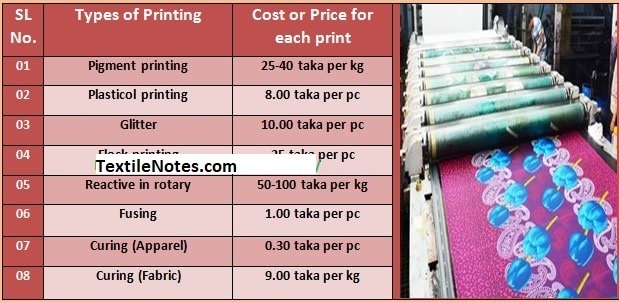
Approximate Cost of Printing in Bangladesh:
| SL No. | Types of Printing | Cost or Price for each print |
| 01 | Pigment printing | 25-40 taka per kg |
| 02 | Plasticol printing | 8.00 taka per pc |
| 03 | Glitter | 10.00 taka per pc |
| 04 | Flock printing | 25 taka per pc |
| 05 | Reactive in rotary | 50-100 taka per kg |
| 06 | Fusing | 1.00 taka per pc |
| 07 | Curing (Apparel) | 0.30 taka per pc |
| 08 | Curing (Fabric) | 9.00 taka per kg |
Textile Printing Paste Manufacturing Plant Cost
A small to medium-scale textile printing paste manufacturing plant typically costs between $50,000 to $500,000+, depending on production capacity, automation level, and location. Major expenses include land, mixing tanks, reactors, storage systems, laboratory setup, utilities, raw materials, labor, and environmental compliance.
Estimated Cost Breakdown
- Land & factory setup: 15–30%
- Machinery & equipment: 35–45%
- Raw materials & chemicals: 20–30%
- Utilities and installation: 5–10%
- Licensing, testing & safety compliance: 3–8%
- Working capital: 10–20%
Main Machinery Required
- Mixing tanks
- High-speed dispersers
- Storage tanks
- Filtering systems
- Filling and packaging machines
- Laboratory testing equipment
Key Raw Materials
- Thickeners
- Pigments or dyes
- Binders
- Emulsifiers
- Water-retaining agents
- Defoamers and additives
Factors That Affect Plant Cost
- Production capacity per day
- Manual vs automated production
- Local labor and land cost
- Imported vs local machinery
- Environmental treatment requirements
- Product quality standard
| Cost Component | Example A: Small-Scale Plant (500 kg/day) | Example B: Medium-Scale Plant (Information not specified) |
|---|---|---|
| Land & Building | $27,900 (approx. 600 sq. ft.) | 150,000−500,000 |
| Plant & Machinery | $24,000 | 100,000−400,000 |
| Working Capital (1 month) | $48,700 | 100,000−300,000 |
| Total Capital Investment | ~$106,000 | 350,000−350,000−1,200,000 |
There are some other ways to Calculate Printing Cost in the Textile and Apparel Industry. This article will give you a comprehensive idea of printing costs.