
Currently, the textile sector is expanding very rapidly. Its production process much improved than before, but these processes are leading contributors to global greenhouse gas emissions, microplastic pollution, and toxic water. Fortunately, modern science has researched and found possible ways to convert textile fibers to support a sustainable circular materials economy within reach. Bio-engineering of fibers at the Nano, micro, and macroscale provides several avenues to improve both the environmental impacts and technical performance of textile materials. Bio based technolog,y like enzyme engineering, to save our environment from being polluted. Finally, it will be said that biotechnology gives us sustainable bio-textile production and also gives us a healthy environment. This article is about the Application and Benefits of Biotextile Engineering in Textile Processing.
Keywords: Biotextile Engineering, Environment, ecology, DNA, pollution, cellulose, ETP, SDG.
I. Introduction:
Bio-fabrication of materials will play an important role in simplifying the transition from an environmentally destructive linear economy to a circular economy.[1] It depends on natural cycling, using an ecologically friendly process to close and minimize materials. Bio-based technology through enzyme engineering using recombinant DNA technology can be used textile industries. It became decrease our environmental pollution. These technologies participate in the finishing process. Microbial enzymes can be participated the process of resizing, bleaching, scouring, bio-finishing, and wastewater treatment in every sector of the textile industry. In general, uses of textile fibers such as nylon and elastane are non-renewable and non-recyclable. These materials have a bad impact on our environment. On the other side, the natural fiber, such as cotton and degradable polymer fiber (polylactic acid) are renewable.
The current textile industry contributes to 10% of global carbon emissions[2] and 20% of global wastewater [3]. As a result, global warming increases gradually, and water is being polluted. Besides, biodegradable products are non-toxic to microorganisms in the environment. For example, collagen fibers can be produced in genetically modified microbes to bio-fabricate leather, and bio-utilization of rapidly renewable biopolymers such as fungal mycelium can create alternative leathers and fabrics. Various bio-fabrication technologies provide significant opportunities for biotextiles with minimal Waste in the textile and Apparel production phase. It also impacts the climate change mitigation potential of the bio-fabrication process and bio-material products. Combined treatment with different enzymes in the same reactor will save time, water, and other elements, along with reduced cost. It also clean environment in the industry.
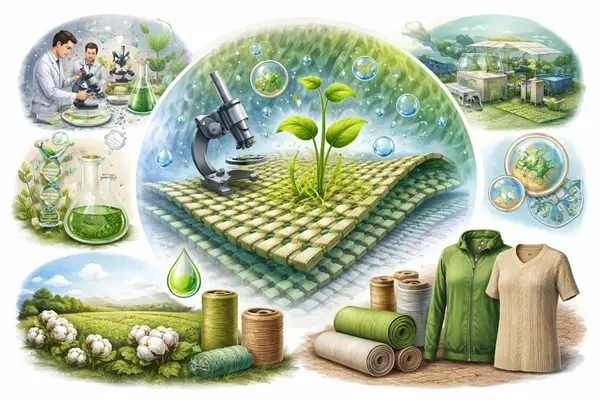
Application of Biotextile Engineering
Protein engineering is very important for orthopedic and surgical applications. In the use of bio-technology, it makes naturally dyed fabrics, waterproof dresses, without the environmental impact of toxic dyes, finishing agents, and petrochemical feedstocks. Synthetic biology and bio-fabrication way to a circular textile economy. Bio-textiles produce the product without environmental impact, toxic dyes, finishing agent and petrochemical feedstock.
It has features for medical devices such as;
- Manufactured with a validated process.
- High degree of radial and tensile strength.
- Extremely flexible to aid in surgery and successfully integrated with the body.
- This textile is thin and lightweight.
- Wool Anti-felting: Protease treatment is a mild method that serves as an alternative to chlorination for preventing shrinkage.
- Silk Degumming: Proteolytic enzymes remove sericin without damaging the fiber and transferring it to the wearer.
‘Coral’ produces naturally dyed fabrics. Spider silk can bear ampullated spidroin, and it produces Kevla,r β-casein exists in cow’s milk. β-casein helps to make a rain jacket. The majority of engineered protein products have been designed for biomedical or pharmaceutical applications. Uses of enzymes in dyeing industries, it reduces environmental pollution, waste of water, and saves cost and time. These nanoscale engineering efforts have enabled the incorporation of red ‘dye’ in bacterial nanocellulose fibers in the form of heterologously expressed RFP and the synthetic production of protein fibers with the tenacity and ductility of spider silk. It removes pectin and other impurities from the primary cell wall of the cotton fibers without degradation of cellulose and thus has no negative effect on the strength properties of the fabric. Plant Cells have been engineered to produce cultural cotton; yeast strains have been developed to ferment collagen and spider silk. Gluconacetobacter has been engineered to improve the production of bacterial nanocellulose.[5]
III. Benefits of Biotextile Engineering in Textile Processing
- Reduced Chemical Use: Utilizes harmless biological agents instead of toxic chemicals such as (alkalis, solvents, metals).
- Lower Energy & Water Consumption: Cleaning and bleaching are often done between 30 and 50 °C and at neutral pH, therefore, the energy and water use is reduced by 30-50%.
- Biodegradability: Eco-friendly fibers as well as finishes minimize the amount of microplastics in the environment and textile disposal.
- Renewable Resources: Petrochemicals are replaced by agricultural residues, microbes, or bio-engineered materials.
- Bio-based technology in the textiles area will be very efficient in reducing environmental pollution.[6]
- It makes sure a sustainable development within the country’s economy.
- If we use enzymes instead of toxic chemicals will make the enzyme one of the most promising tools for textile industries.
- Biotechnology is a blessing for good health, saves money and time, energy, and water in the industrial sector.
- It helps to get cleaner industrial products.
- It works to establish a bio-based technique as an effluent treatment plant (ETP).
- This Process will be help to make sure green textile.
- It also fills up Sustainable Development Goal (SDG).
IV. Demerits
- Enzymes can be high cost to produce.
- Have to feed microbes properly.[6]
V. Conclusion
In textile industry, chemicals are used in this manufacturing process are extremely uses which is a serious threat to the environment. Bio-technology will be work to solve this problem. Since, textiles will be lost as long as the earth; there is no substitute for bio-textiles to make the earth a pollution free environment. To use Bio-technology in textile sector also help to progress economic condition. Finally, it will be said that biodegradable products are blessing for human.
Biotextile engineering combines biotechnology, microbiology, and materials science with modern textile technology to create or alter textiles through the use of biological systems, organisms, or biomimetic methods. It covers a wide range of applications, such as the use of enzymes, microorganisms, bioactive compounds, and bio-based materials in textile production and finishing.
References:
[1]. MacArthur, E., 2013. Towards the circular economy. Journal of Industrial Ecology, 2(1), pp.23-44. https://www.werktrends.nl/app/uploads/2015/06/Rapport_McKinsey-Towards_A_Circular_Economy.pdf
[2] Chrobot, P., Faist, M., Gustavus, L., Martin, A., Stamm, A., Zollinger, M. and Zah, R., 2018. Measuring fashion: Environmental impact of the global apparel and footwear industries study. Full report and methodological considerations.https://quantis.com/report/measuring-fashion-report/
[3] Weltbank, 2014. The Bangladesh Responsible Sourcing Initiative: A New Model for Green Growth.https://documents.worldbank.org/en/publication/documents-reports/documentdetail/614901468768707543/the-bangladesh-responsible-sourcing-initiative-a-new-model-for-green-growth
[4] Qian, Z.G., Pan, F. and Xia, X.X., 2020. Synthetic biology for protein-based materials. Current Opinion in Biotechnology, 65, pp.197-204.https://www.sciencedirect.com/science/article/abs/pii/S0958166920300537
[5] Chien, L.J., Chen, H.T., Yang, P.F. and Lee, C.K., 2006. Enhancement of cellulose pellicle production by constitutively expressing Vitreoscilla hemoglobin in Acetobacter xylinum. Biotechnology progress, 22(6), pp.1598-1603.https://www.scopus.com/record/display.uri?eid=2-s2.0-33845503485&origin=inward&txGid=a8cdf41101c7f3485b33661b5bc3c3bd
[6] F. T.Johra, Md.N. U. Titu,2020. Enzyme Engineering for Developing a Sustainable Bio Based Textile to Be a Green alternative to Chemicals in Textiles. https://www.biodesign-conference.com/2020/biodesign_upload/20201130051712_4143_6535.pdf
- Sayeada Tayeaba Ruhi
- Chittagong Textile Engineering College, Zorarganj.