
IE Department in the Garments Industry
IE is the Industrial Engineering department in the garments industry. They lead and control the sewing and other operations. Improve processes on the production floor by implementing Lean tools and IE methods. Analyze bottleneck areas in the production line and develop countermeasures to ensure smooth material flow. In this article, we discuss the IE Department in the Garments Industry.
They are result-oriented, creative individuals with work experience in multicultural environments. Directly worked with Toyota consultants to implement the Lean Manufacturing System in the organization. Data and fact-driven mindset with an emphasis on turning data into information, information into insight, and insight into business decisions. Specialized in implementing SOPs, processes, methods, and Tools to roll out and build the organizational structure for smooth operation to achieve the long-term company’s goal, mission & vision. These are the KPI of the IE Department in the Garments Industry.
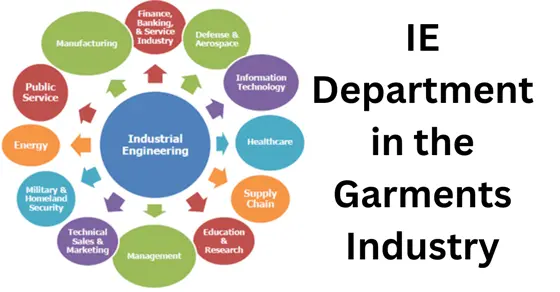
Key Task of the IE Department in the Garments Industry
- Operation breakdown and make a paper layout. Machine layout preparation, line SMV, and efficiency calculation.
- Proper line balancing by the given and taken operators from other lines.
- Process development, line target setup, method study, time study, motion study, to identify bottleneck areas and solve problems of the line
- To ensure smooth production flow, calculate non-productive time, and reduce defects and wastage.
- Floor monitoring, machine operator recruitment by skill test and grading, to train, motivate, and guide production in-charge, line chief, line supervisor, workers for better production & efficiency, and any other task given by the Department.
Daily Routine Job Responsibilities of the Industrial Engineering department in the garments industry:
- Check the absenteeism report and the cooperation line chief to set the right operator in the right place.
- Proper line balancing by the given and taken operators from other lines.
- Motion analysis of an operator for reduces his/her unnecessary working time.
- Make a new style layout.
- Follow up process-wise hourly production and find any problems, then apply techniques for the solution.
- Daily production efficiency report prepared.
- Measuring line lost time due to various reasons in the sewing floor, such as input delay, feeding delay, bus being late, machine breakdown, printing delay, etc.
- Check the machine breakdown report and discuss with the mechanic to reduce production lost time by repairing the machine quickly.
- Every month, a line-wise machine list is prepared.
- New style-wise machine and folder analysis report prepared.
- After line feeding, I check process-wise cycle time by using a stopwatch to make an actual layout.
- If I find out low skill operator, then I use techniques such as production study, time study, etc. to improve his/her skill.
- Recruitment of a new operator/helper takes an interview.
- Process flow mapping of current status to future status by eliminating non- value added activities.
- Determine the best methods and set the SAM/standard minute rates accordingly.
- Aid the management in improving efficiency/utilization and reducing excess cost.
- Work with the management team on performance boosting and line balancing.
- The IE Department reviews workplace/factory layouts and workflow methods.
- Build a database of historical information and keep accurate records of all rates and style details.
- Evaluate potential machinery investments and payback periods.
The Industrial Engineering (IE) department in the garments industry is the backbone of the modern production process and operation. So nowadays in the garments factory; IE run the operation process.