
The method of applying color to the fiber stock, yarn, or fabric is termed dyeing. There may or may not be thorough penetration of the colorant into the yarns or fibers. Here, we present how to Calculate Fabric Dyeing Cost per kg in the textile industry.
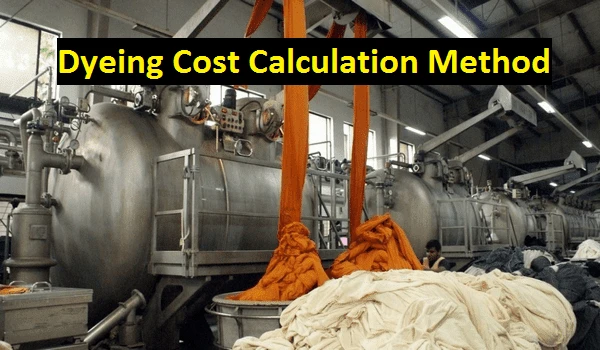
Methods of Dyeing in Textiles:
There are nine types of dyeing methods in the textile industry. Those are listed in the following:
- Bale Dyeing,
- Cross Dyeing,
- Random Dyeing,
- Beam Dyeing,
- Jig Dyeing,
- Batik Dyeing,
- Chain Dyeing,
- Burl or speck Dyeing,
- Piece Dyeing.
Fabric Dyeing Cost Calculation Formula in Wet Processing:
To find out the dyeing cost in the textile wet processing industry, the following formula has to be followed:
Fabric Dyeing cost per kg,
D.M+ D.L+ D.E+ OH
= ………………………………………
Total dyeing production
Where,
D.M = Direct materials cost,
D.L = Direct labor cost,
D.E = Direct expense cost,
OH = Overhead cost.
Elements of Dyeing Cost:
The cost elements involved in the textile dyeing process are as follows:
Direct materials cost (D.M) = Dyes and chemicals,
Direct labor cost (D.L) = Operators and helpers for a definite job,
Direct expense cost (D.E) = Cost of re-dyeing, re-washing, etc.
Overhead cost (OH) = Power, steam, rent, effluent treatment, transport, laboratory, etc.
Key Factors of Fabric Dyeing Cost in Textile:
There are some key points or factors that directly affect textile dyeing costs. Those are presented in the following:
- Special dyes and chemicals.
- Types of dyeing- reactive, direct, vat, sulfur, etc.
- Fabric types- delicate, blended, light, or heavy fabric, etc.
- Dyeing processing time.
- Effluent treatment cost.
- Types of dyeing machine– soft flow, winch dyeing machine,e etc.
- Types of color: medium, light, dark.
- Laboratory expenses.
Approximate Dyeing Cost in Bangladeshi Dyeing Factories:
Approximate cost examples of different levels of colors in the textile dyeing process are as follows:
| SL No. | Parameters | Winch (Per kg) | Soft Flow (Per kg) |
| 01 | Bleaching or whitening | 38 taka | 50 taka |
| 02 | Light color | 65-75 taka | 75-100 taka |
| 03 | Medium color | 75-90 taka | 100-130 taka |
| 04 | Dark color | 100-115 taka | 130-150 taka |
| 05 | Washing | 13 taka | 13 – 20 taka |
Estimation of Dyeing Cost in Textile Sector/ How to Calculate Fabric Dyeing Cost per kg Basis
To know the dyeing cost calculation is very important for all the people related to the textile dyeing job. There are so many who still don’t know the actual method of dyeing cost calculation in the wet processing industry. This article will be very useful for them.
Fabric Dyeing Cost Calculation Method in the Textile Industry:
Find out the dyeing cost and rate per kg from the given chart.
| Parameters | Amount or Quantity |
| Fabric quantity | 400kg |
| Dye A consumed | 5kg |
| Dye B consumed | 3kg |
| Dye C consumed | 2kg |
| Chemical A consumed | 50kg |
| Chemical B consumed | 10kg |
| Shift in a day | 3 shift |
| Total process time | 12hrs |
| No. of labors | 3 |
| Labor wages | Rs. 200 per shift |
| Steam | Rs. 75000 per month |
| Power | Rs. 50000 per month |
| Transport | Rs. 20000 per month |
| Salary | Rs. 100000 per month |
| Other expenses | Rs. 120000 per month |
| Dyes A price | Rs. 250 per kg |
| Dyes B price | Rs. 300 per kg |
| Dyes C price | Rs. 400 per kg |
| Chemical A price | Rs. 5 per kg |
| Chemical B price | Rs. 50 per kg |
| Profit | 20% |
Solution:
To calculate the fabric dyeing cost in the textile sector, the following formula has to be maintained:
Dyeing cost per kg,
Direct materials (D.M) + Direct labor (D.L) + Direct expense (D.E) + Overhead
= ………………………………………………………………………………………….… ….. (1)
Total dyeing production
Total Dyeing Production Calculation:
Total production
= Fabric input
= 400kg
Total Production Time Calculation:
Total production calculation,
= Process time
= 16hrs
= (16/8) shift
= 2 shift
Direct Material Cost (D.M.) Calculation:
Dye A cost = Amount of dye × Dye price = 5×Rs. 250 = Rs. 1250
Dye B cost = Amount of dye × Dye price = 3×Rs. 300 = Rs. 900
Dye C cost = Amount of dye × Dye price = 2×Rs. 400 = Rs. 800
Chemical A cost = Amount of chemical × Chemical price = 50×Rs. 5 = Rs. 250
Chemical B cost = Amount of chemical × Chemical price = 30×Rs. 50 = Rs. 1500
So,
Dyeing material cost stands at
= Rs. 1250 + Rs. 900 + Rs. 800 + Rs. 250 + Rs. 1500
= Rs. 4700
Direct Labor Cost (D.L.) Calculation:
Operator wages,
= No. of labor × No. of shift × labor wage per shift
= 4×2×Rs. 200
= Rs. 1600
Direct Expense Cost (D.E) Calculation:
Direct expense = 0
Overhead Cost Calculation:
In the case of steam,
= {(Cost × 2 shifts)/ (30days × 3 shifts in a day)} = {(75000×2)/90} = Rs. 1667
In the case of transport,
= {(Cost × 2 shifts)/ (30days × 3 shifts in a day)} = {(20000×2)/90} = Rs. 445
In the case of power,
= {(Cost × 2 shifts)/ (30days × 3 shifts in a day)} = {(50000×2)/90} = Rs. 1112
In the case of salary,
= {(Cost × 2 shifts)/ (30days × 3 shifts in a day)} = {(100000×2)/90} = Rs. 2224
In case of other expenses,
= {(Cost × 2 shifts)/ (30days × 3 shifts in a day)} = {(120000×2)/90} = Rs. 2667
So,
Total overheads,
= Rs. 1667 + Rs. 1112 + Rs. 445 + Rs. 2224 + Rs. 2667
= Rs. 8115
Now, from equation (1), we get,
Dyeing cost per kg,
= {(4700+ 1600+ 0+ 8115)/400}
= Rs. 36.00
After adding 20% profit, the dyeing rate stands at
= {36/ (1-20%)}
= Rs. 45.00
- You may love to read: Top 100 Dyeing Machine Manufacturer List in World.