
The importance of buying house can’t be described in a word. A trading house is also an important business entity. The functions them is not the same. There are some basic differences between buying house and trading house. This article is all about the Difference Between Buying House and Trading House.
The buying house finds out the foreign buyers, places orders, communicates with the manufacturers, and takes all the responsibility of getting the order done. Whereas, the trading house does the transaction job and eases the process between home and abroad companies.
The global apparel and textile industry relies on various intermediaries to connect manufacturers with international buyers. Two of the most common business models are the Buying House and the Trading House. Although these terms are often used interchangeably, they perform very different functions within the supply chain.
Buying House
Buying house is the working place of merchandizers. The basic function of the buying house is to communicate with the buyers of other countries who are interested to buy garment products. Quality products at a lower price are possible in our RMG industry. So, the overseas buying house places their orders to us quite frequently. Some other sections are also part of buying house, like QC, supply chain.
Main Functions of a Buying House
Supplier Identification
Buying houses involves identifying suitable manufacturers based on:
- Production capacity
- Product specialization
- Compliance standards
- Quality performance
- Cost competitiveness
Trading House
Trading house is such a type of business which aids the transaction between the home companies and abroad companies. It can be said that it is an importer, exporter, and even a trader. It purchases products and then sells the products also for other business. They act as intermediaries for manufacturers to trade their business in foreign locations.
The trading house assumes commercial responsibility and often handles:
- Purchasing
- Inventory management
- Export documentation
- Shipping
- Sales
In many cases, buyers do not directly communicate with the manufacturing factory.
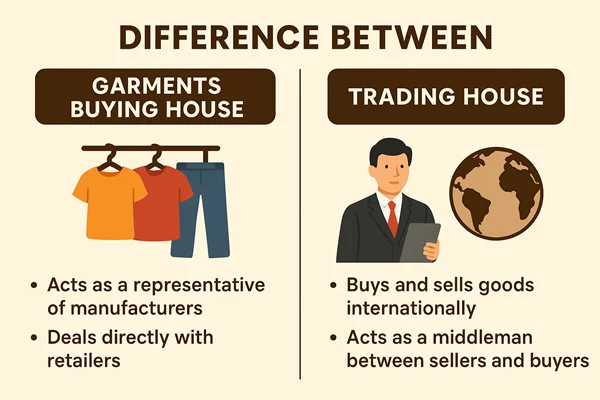
7 Difference Between Buying House and Trading House
| Buying House | Trading House |
| Owned by the buyer | Not owned by the buyer |
| Buying house has its’ own brand | Doesn’t have own brand |
| Buying house can directly place order to the manufacturing plant or can place order through the trading house | They always directly place order to the manufacturing plant by taking it from the buyer |
| It has many outlets | No outlets |
| Buying house has less risk | Takes more risk because if the order is not according to the buyer then it has to take the risk of money |
| Job of buying house quite easier | This job is quite difficult as it has to communicate with both the buying house and manufacturing plant |
| · Example- H&M which is located at Sweden · It has more than 4000 outlets . Net worth more than $2 B | · Example- Li-fung · Works for only retailer buyer . Net worth more than $1 B |
Buying house as well as trading house both of them plays a tremendous job in our RMG sector to achieve the revenue. This sectors help to build up strong economic support for our local industries.
Although both buying houses and trading houses serve as intermediaries between manufacturers and buyers, their business models differ significantly. A buying house primarily represents the buyer, focusing on sourcing, quality control, compliance, and production monitoring without owning the goods. In contrast, a trading house purchases products from manufacturers and resells them to customers, assuming commercial ownership and related risks.
Understanding these differences helps manufacturers, exporters, sourcing professionals, and international buyers make informed decisions and build more effective supply chain partnerships in today’s competitive global marketplace.