Both Dye and Pigment are coloring agents for sure. But they are not the same. So now the question is coming, what are the differences between the two coloring agents? In this article, we are discussing What is the Difference Between Dye and Pigment.
Dye
It is a colored substance that has been applied to the substrate for which it is being applied. In wet processing technology, the dye is normally applied in an aqueous solution. It should be pointed out that the dye may require a mordant to develop the fastness properties of the dye on the fiber.
- Soluble in the medium they’re used in, usually water or a solvent.
- Penetrate the fiber or material and bond at a molecular level.
- Give brighter, deeper shades with a smooth finish.
- Lower resistance to light, washing, and chemicals compared to pigments.
- Common in textile dyeing, inks, food coloring, and paper.
What Types of dyes are used in Textile Wet Processing?
There are different types of dyes used in textile wet process industries, which are mentioned below:
- Acid dye,
- Basic dye,
- Direct dye,
- Mordant dye,
- Vat dye,
- Reactive dye,
- Disperse dye,
- Azoic dye,
- Sulfur dye.
Pigment
In the textile industry, the pigment is a material that changes the color of transmitted or reflected light due to wavelength-selective absorption. This type of physical procedure compares phosphorescence, fluorescence, and also the remaining forms of luminescence, where a material emits light.
- Insoluble particles that stay suspended in the medium.
- Sit on the surface and need a binder to stick.
- Colors look more solid and opaque.
- Excellent lightfastness, wash fastness, and chemical resistance.
- Used in paints, plastics, printing inks, coatings, and textile pigment printing.
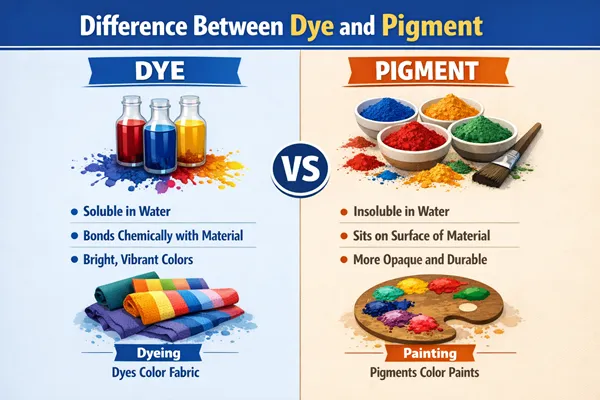
What is the Difference Between Dye and Pigment?
Some key differences between dye and pigment are discussed in the table below:
| SL No. | Dye | Pigment |
| 01 | Dye has 70% water solubility. | The pigment has 100% water solubility. |
| 02 | Dye has fastness characteristics or properties. | The pigment has good fastness properties. |
| 03 | Most of all the dyes are organic compounds and the remaining are metallic compounds. | Most of the pigments are inorganic compounds. |
| 04 | Dye diffusion in fabric. | Pigment diffusion on the fabric. |
| 05 | It’s not possible to dye all types of fabric by using dye. | All types of fabric can be dyed by using this. |
| 06 | No binding agent is required in the case of dye. | The binding agent is required in the case of pigment. |
| 07 | It is costly as these are prepared chemically. | It is cheap as these are found by mineral origin. |
Conclusion
Dyes become part of the material. Pigments stay on top of it. If you want vibrancy and softness, dye wins. If you want durability and stability, pigment is the better choice. Dye bonds with the material; pigment sticks with the help of a binder.