Some essential knitting calculations describe the whole idea of total knitting calculations. This article is all about Some Essential Knitting Production Calculation Formulas. As a thumb rule, knitting consultants value more highly to use such a knitting machine whose gauges is just about the count of yarn (English count), i.e., for 20-gauge machines most suitable yarn count is 20s. This rule has certain limitations, like, for 28-gauge yarn of 26s to 30s is most fitted. Except for terribly fine counts, this rule isn’t applicable, and additionally, machines have most gauge thirty two. Normally, fine counts are not used intrinsically rathe,r they’re create double, like count 60s double, which means that the web count is just about 30s. And this sixty double count is appropriate for a 30-gauge machine.
To solve this drawback, some authors have recommended the following formulas.
List of Some Essential Knitting Production Calculation Formulas:
For single textile machine suitable count = G*G/18. For Double textile machine suitable count= G*G/8.4
Where G is gauge of textile machine. Some textile machine makers counsel a spread of yarn count for his or her machine. There is differently to unravel this drawback which is to require facilitate from recent record. Each firm is manufacturing many varieties of fabrics and on the premise of experience they develop a info for prepared reference. One will get a prepared reference from the table to professionalduce material of scrummage. We have a tendency to also are giving expected breadth of fabric when wet process. This table will offer simply a reference. Knitters have to determine by themselves after doing an attempt production, since there are many a lot of factors, which can affect yarn and gauge choice method.
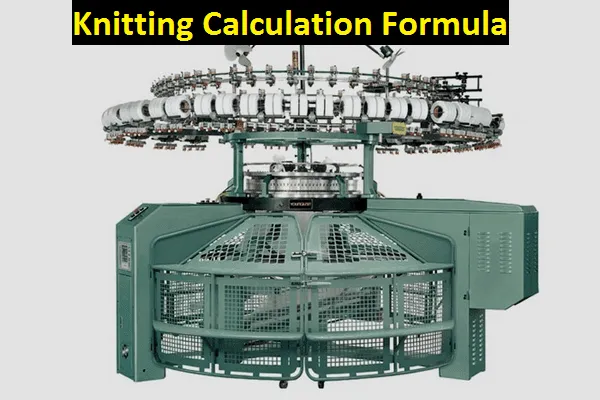
Knitting Machine Parameters
Every textile machine is created to fulfill sure demands of the client. There are range of characteristics of machine which are intimated by the machine makers whereas delivering the machine to customers/users. It is useful for the user to be aware of these parameters. What is more machine specifications ar given in several unit. We will justify these parameters and can additionally provide the factors to convert parameters from one system to different.
- Machine Gauge
As per Oxford wordbook the word “gauge” may be a noun and furthermore as verb. It is used to live level of associate degree issue or for an instrument to live breadth, length or height of any issue. In knitting it’s wont to specific the quantity of inheritable during a unit length of the needle bed. This needle bed could Flatbed Knitting Machine or a circular. In knit circular machine it’s used for cylinder and furthermore as dial. Generally gauge is outlined as range of needles per inch. According to German customary DIN 60917 (Iyer et al 1995) alphabet “E “ is used to denote textile machine gauge.
E = range of needles 1 inch (25.4 mm)
Example 01
Calculate nominal production of one jersey-knitting machine per hour from the information given:
Machine Gauge = 24, Machine United States intelligence agency= 30 inches, Number of Feeders = 90, Machine rate = 26, Yarn Count = 24, Stitch length = 4 mm, Efficiency = 85%
Solution 01
Step one
First we’ll calculate number of needles and range of stitches created in one revolution. This is able to facilitate United States in calculative the full length of yarn consumed in one revolution.
Number of needles = machine United States intelligence agency * gauge *
π
ππ
π
(3.14)
= 30* 24*3.14
=2260 (exact 2260.8 however needles ar continuously in even number so we’ll take nearest even figure)
Number of stitches created in revolution.
Every needle is creating one sew on each feeder because machine is producing single jersey material (full knit fabric).
Number of stitches created in one revolution = Number of needles * range of feeders
= 2260*90
= 203400
This figure shows that machine is creating 203400 stitches in one revolution.
Step Two
Length of sew is 04 millimeter ( we calculate stitch length usually in metric system). From this figure we are able to calculate yarn consumption in yards in one hour.
Yarn Consumption (in yards) in one hour = range of stitches * length of (mm) * rate *60 (minutes)/ 1000(to convert millimeter into meters)
=203400 * four * twenty six * sixty /1000
= 1269216 meters or
= 1388015 yards
Step Three
In previous step we have a tendency to calculated amount of yarn consumed in yards. We can easily calculate weight of this yarn.
Weight of cotton yarn = length of yarn
Count * 840
= 1388015
840 * 24
= 68.85 pounds or
= 31.23 weight unit grams
Efficiency eighty fifth
= 26.55 weight unit grams
Answer: this machine will manufacture twenty six.55 Kgs material in one hour at eighty five yuletide efficiency
Example 02
For Filament yarn, Calculate nominal production of a single jersey-knitting machine per hour from the information given: Machine Gauge=28, Machine United States intelligence agency= 26 inches, Number of Feeders = 120, Machine rate = 30, Yarn Denier= 75, Stitch length=4.5 mm, Efficiency= 85%
Solution 02
Step one
First we’ll calculate range of needles and number of stitches created in one revolution. this is able to facilitate. United States in calculative the total length of yarn consumed in one revolution.
Number of needles = machine United States intelligence agency * gauge *
π
ππ
π
(3.14)
= 26* 28*3.14
=2286 (exact 2285.92 however needles are continuously in even number so we will take nearest even figure)
Number of stitches created in revolution.
Every needle is creating one sew on each feeder because machine is producing single jersey material (full knit fabric).
Number of stitches created in one revolution = Number of needles * range of feeders
= 2286*120
= 274320
This figure shows that machine is creating 274320 stitches in one evolution.
Step Two
Length of sew is 04.5 millimeter (we calculate stitch length always in metric system).
From this figure we are able to calculate yarn consumption in yards in one hour.
Yarn Consumption (in yards) in one hour= range of stitches * length of (mm) * rate *60 (minutes)1000(to convert millimeter into meters)
=274320 * four.5 * thirty * sixty
1000
= 2221992 meters
Step Three
In previous step we have a tendency to calculated amount of yarn consumed in yards. We can easily calculate weight of this yarn whereas its count/denier
Weight of filament in grams = Length in meters * denier / 9000
= 2221992*75/9000
Answer
=18516 grams or
=18.516 Kgs
Efficiency eighty fifth
= 18.516*85%
=15.74 Kgs
Answer: this machine will manufacture fifteen.74 Kgs material in one hour at eighty five yuletide efficiency
Note: if we have a tendency to manufacture any rough material, like fleece, then we have a tendency to use different yarns at totally feeders and ultimately stitch length is additionally completely different.
Calculate Knitting Production in Textile
To calculate the knitting production in textiles, you have to know a formula. In another article, I have shared the production calculation of a circular knitting machine. This article has presented some important formulas of knitting calculation with examples. Hope it will be very useful in your job profession.
Knitting Production Calculation Formula:
Some important formula of knitting production calculation have mentioned in the below:
1. Production in length,
= Course per minute/ Course per inch,
Or,
= CPM/CPI
Or,
Number of feeder× cylinder RPM× time× efficiency
=…………………………………………………………………..
CPI×36
2. Course per inch,
= Course per minute/production in length
3. Course per minute,
= course per inch× production in length
4. Stitch density,
= Course per cm/ Wales per cm
5. Fabric width,
= {(∏× diameter of cylinder× machine gauge)/wales per cm}
Or,
= Number of wales/Wales per cm
Or,
= Number of needle/ wales per cm
6. Fabric weight,
= {(Course per minute× yarn length per course)/ yarn count}
7. Needle number of machine,
= ∏× diameter of cylinder× gauge
8. Yarn length per course,
= Total number of machine× loop length
9. Production of single jersey machine in weight (kg) per hour,
∏×cylinder dia (inch)×cylinder RPM× feeder no.× gauge×stitch length (mm)× tex×60×efficiency
=……………………………………………………………………………………………..……………
1000×1000×1000
10. Production of double jersey in length,
= Single jersey production in length/2
11. Production of double jersey in weight,
= Single jersey ×2
Production Calculation of Knitting Machine in Textile:
Example-01:
If machine diameter= 20 inch, feeder number= 90, course per cm= 15, machine speed= 25 RPM and machine efficiency is 90% then calculate the production per shift of a single jersey circular knitting machine.
Solution:
Here,
Diameter of machine= 20 inch,
Number of feeder= 90,
Machine speed or machine cylinder RPM= 25 RPM,
Machine efficiency= 90%= 0.9,
Time= 1 shift= 8 hours = (8×60) =480 minute
Course per cm= 15,
Course per inch (CPI) = (15/0.3937) = 38.10≈38
So,
Production in meter per shift,
No. of feeder× cylinder RPM× time× efficiency
=…………………………………………………………..
CPI×36
90×25×480×0.9
=……………………….
38×36
= 710.53 yds
= (710.53×0.9144) m
= 649.7 m per shift
So, production per shift for single jersey circular knitting machine is 649.7m
Example-02:
Calculate the length in meter of a plain single jersey fabric at 16 courses per centimeter on a 26 inch diameter and 28 gauge machine having 100 feeders. The knitting machine operates for 8 hours at 29 RPM at efficiency of 90%.
Solution:
Given that,
Machine dia= 26 inch,
Machine gauge= 28,
Number of feeder= 100,
Machine speed or cylinder RPM=29 RPM,
Efficiency= 90%= 0.9,
Time= 8 hours= (8×60) =480 minute,
Course per centimeter= 16,
Course per inch (CPI) = 16/0.3937=40.64≈41
So,
Production in meter per shift,
Number of feeder× machine speed× time× efficiency
=…………………………………………………………………..
CPI×36
100×29×480×0.9
=………………………….
41×36
= 848.78 meter per 8 hours,
= (848.78×0.9144) m
= 776.12 m per 8 hours
So, production for this calculation stands at 776.12m per 8 hours.