
When you browse a website to get a print on your favorite t-shirt, you will see some common printing methods. Screen printing, DTG, heat transfer, etc, are very common for printing tees. Choosing the right decoration method for printing t-shirts, apparel, or promotional products is crucial. The two most popular methods—screen printing and heat transfer— always come up as top contenders. But which one is right for your project? Let’s discuss Heat Transfer Printing vs Screen Printing: 10 Key Differences between them.
Thanks to advanced technology, with its help, tons of T-shirts can be printed within a very short time. You can also Print Your Tees At Home with a small setup. All three processes have their own advantages. You can select which process suits you best, depending on the discussion below. If you want a good quality, long-lasting, vibrant print, then go with screen printing. If you want a lot of tees printed within a very short time, then you have to go with heat transfer. Find the comprehensive discussion on the Heat Transfer Printing vs Screen Printing below.
Screen Printing:
This is a traditional, analog process. A stencil (the “screen”) is created for each color in your design. Ink is then pushed through these screens onto the garment one color at a time. Each color requires a separate screen, setup, and pass through the press. Screen printing is a new scopes of the techniques of stenciling in which a colored picture or image arise from the transfer of color through open areas in the sheet placed upon the fabric surface.
Heat Transfer (DTF/DTG Transfer):
This is a rather modern method and intrinsically digital. Your design is printed in full color with high resolution onto a special film or transfer paper. This printed film is then placed firmly onto the fabric, where a heat press attaches the ink to the fabric permanently. The printing process uses heat and pressure.
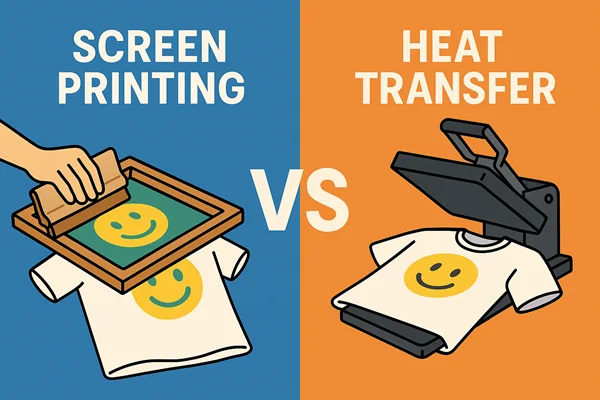
Heat Transfer Printing vs Screen Printing: 10 Key Differences
Explore all the details on Heat Transfer Printing vs Screen Printing in the following table. It is the difference between Heat Transfer Printing and Screen Printing:
| Topics | Screen Printing | Heat Transfer |
| Process | A stencil (screen) is prepared for each color. Ink is pushed through the screen onto the textile using a squeegee. Each color is applied separately and then cured. | A design is first printed onto special transfer paper using ink that reacts to heat. The paper is placed on the fabric, and a heat press applies pressure and high temperature, transferring the design onto the textile. |
| Quality | Generally produces higher quality prints with crisp edges and smooth ink laydown. | Quality is good but usually not as sharp or long-lasting as screen printing. Can feel like a plasticky layer on the fabric. |
| Tools | Stencil (screen), frame, squeegee, ink, exposure unit, curing equipment | Heat press machine (or a household iron for small DIY projects), transfer paper, printer (for custom designs) |
| Color range | Multi-color printing is possible, but each color needs a separate screen. This makes complex, multi-color designs more expensive and time-consuming. | Ideal for designs with many colors (e.g., photographs or gradients) because the transfer paper is printed all at once. No extra cost for additional colors. |
| Best suited for | Large batch orders. Very cost-effective when printing hundreds of identical items. Not ideal for small runs (due to setup cost). | Small orders, single items, or on-demand printing. Great for personalized designs and sampling. |
| Color vibrancy | Produces bright, opaque, and vibrant colors, especially on dark fabrics (with an underbase). | Colors can look slightly duller, especially on dark fabrics unless using special transfer paper. Glossy or matte finishes are possible. |
| Time required | Setup is time-consuming (coating screens, drying, aligning). However, once set up, printing bulk orders is very fast. | Very quick setup – just print the transfer and press. Faster for small quantities. |
| Cost effectiveness | Very cost-effective for bulk orders. Cost increases with the number of screens (colors). For small orders (e.g., 1–20 pieces), it’s not economical. | More cost-effective for small orders – no setup fees, and you pay only per transfer. For large bulk orders, it becomes more expensive than screen printing. |
| Durability | Highly durable. Ink bonds deep into the fabric fibers. Can withstand 50+ washes with minimal fading if cured properly. | Less durable. The design sits more on top of the fabric. Cracking, peeling, or fading can occur after 10–20 washes, especially with home irons. |
| Photographic / detailed designs | Not suitable for photographic designs (gradients, fine details, millions of colors). Works best with solid colors and vector art. | Excellent for photographic and highly detailed designs. Can reproduce gradients, shadows, and complex artwork easily. |
| Fabric compatibility | Works well on cotton, blends, and most woven fabrics. Not ideal on extremely stretchy or heat-sensitive materials. | Works on a wide range of fabrics, including polyester and performance wear. Some materials (e.g., nylon) may require special transfer paper. |
| Feel / texture | Leaves a soft, thin layer of ink. Can feel slightly raised but blends into the fabric. Discharge or water-based inks feel even softer. | Often leaves a plasticky or rubbery feel on the fabric. Newer “soft-hand” transfers are better but still more noticeable than screen printing. |
Always communicate with your printing service provider. Discuss your project goals, budget, and expectations. As you already have a great idea of Screen Printing vs Heat Transfer, a good printing process will guide you toward the best method to ensure your final product looks and feels exactly how you envision it.
Heat Transfer Printing vs Screen Printing? Honestly choosing between heat transfer printing and screen printing really comes down to what you need for production, how complex your design is, how many pieces you’re making, and what budget you can deal with. Heat transfer printing usually works best for shorter runs, customized garments, and full color designs where the tiny, intricate details matter, while screen printing is still the go to option for big volume jobs because it tends to last longer, it’s more cost efficient, and it delivers very vivid color output.