
Walk into almost any conversation about sustainable textiles today, and one material keeps coming up: PLA fiber. Short for polylactic acid, PLA has quietly moved from a niche bioplastic used in 3D printing filament to one of the most talked-about raw materials in nonwovens, hygiene products, filtration, and home textiles. It’s plant-derived, it’s compostable under the right conditions, and — perhaps most importantly for manufacturers — it performs a lot like the petroleum-based fibers it’s replacing.
In this guide, we’ll break down what PLA Fiber actually is, how it’s made, where it’s used, and why so many companies are shifting toward it. We’ll also look closely at two specific product forms — PLA Staple and PLA Bi-component Staple — since these are the workhorse formats behind most real-world PLA applications.
Much of this shift has been made possible by dedicated bio-polymer fiber producers rather than generalist synthetic fiber mills. eSUN is one of the manufacturers that has focused specifically on this space, building out production capability around its PLA Fiber line — covering polymer processing, staple cutting, and bi-component spinning — rather than treating PLA as a side product alongside conventional polyester lines. That kind of focus tends to matter in practice: PLA is more sensitive to processing temperature and moisture than PET, so consistent fiber quality depends heavily on a producer’s process control and polymer sourcing discipline. Throughout this guide, we’ll reference how eSUN’s PLA Fiber range approaches these product categories as a practical example of how the specs discussed below translate into real, sourceable material.
What Is PLA Fiber, Exactly?
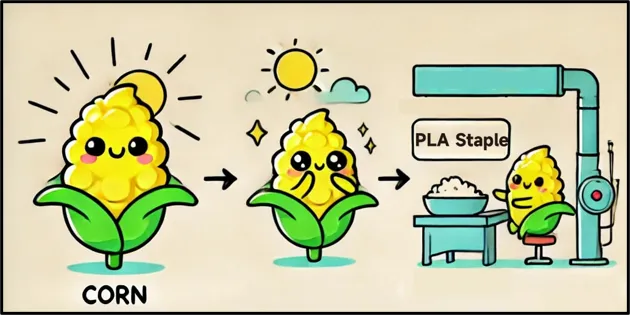
PLA fiber is spun from polylactic acid, a polymer made by fermenting plant sugars — typically sourced from corn starch, sugarcane, or cassava — into lactic acid, which is then polymerized into long polyester-like chains. Unlike conventional polyester (PET), which relies on crude oil as a feedstock, PLA starts its life in a farm field rather than a refinery. Once the polymer is produced, it’s extruded through spinnerets to form continuous filaments, which are then either kept as filament yarn or cut down into short lengths known as staple fiber. That staple form is what feeds into carding lines, needle-punch machines, and thermal bonding equipment used to make nonwoven fabrics, fiberfill, and blended yarns.
Why Manufacturers Are Paying Attention to PLA
A few years ago, PLA fiber was mostly a curiosity for eco-conscious startups. That’s changed. Regulatory pressure on single-use plastics, retailer sustainability commitments, and genuine consumer demand for lower-impact materials have pushed PLA into mainstream sourcing conversations. A handful of practical reasons explain why:
- Renewable feedstock: PLA is made from annually renewable crops instead of finite fossil resources.
- Lower carbon footprint: Life-cycle studies generally show PLA production generates fewer greenhouse gas emissions than conventional polyester, though the exact number depends on farming and processing methods.
- Compostability: Under industrial composting conditions, PLA breaks down into water, carbon dioxide, and biomass, unlike PET which persists in the environment for decades.
- Comparable performance: PLA fiber has a hand-feel, tenacity, and processability that’s close enough to polyester that it can often be swapped into existing production lines with minimal retooling.
- Naturally hypoallergenic and low-odor: This makes it popular in hygiene and bedding applications where skin contact matters.
PLA Staple Fiber: The Building Block
PLA Staple refers to PLA filament that has been cut into short, uniform lengths — commonly anywhere from 32mm to 76mm depending on the end application. This cut-length format is essential because most nonwoven and yarn-spinning equipment is designed to process staple fiber rather than continuous filament. Once cut, PLA staple fiber can be carded into batts, needle-punched into felt, thermally bonded into nonwoven rolls, or blended with cotton, wool, or other natural fibers to create spun yarns. Because the fiber is inherently biodegradable, products made from it — think wipes, agricultural mulch mats, or disposable hygiene layers — can be designed with an end-of-life plan that doesn’t involve a landfill sitting there for 200 years. Common deniers for PLA staple range from fine 1.2–1.5 denier fibers used in soft nonwovens to heavier 6–15 denier fibers used in fiberfill and padding applications. The flexibility in denier, crimp, and cut length is part of why staple fiber remains the most widely used PLA format across industries. eSUN’s PLA Fiber range includes PLA Staple produced across this same denier and cut-length spread, which is what allows the same base fiber to serve both lightweight hygiene nonwovens and heavier fiberfill applications without switching suppliers or requalifying a new material mid-production.
PLA Bi-component Staple: Engineering Two Polymers Into One Fiber
While standard PLA staple is a single-polymer fiber, PLA Bi-component Staple takes things a step further by combining two different polymer components within a single filament — typically arranged in a sheath-core or side-by-side structure. A common configuration pairs a lower-melting-point PLA sheath around a higher-melting-point PLA (or other biopolymer) core. When this fiber is exposed to heat during thermal bonding, the outer sheath softens and fuses to neighboring fibers while the core retains its structural integrity. The result is a nonwoven fabric that’s self-bonding — no additional binder chemicals or resins are needed to hold the web together. This matters for a few reasons:
- Cleaner chemistry: Eliminating latex or chemical binders makes the final nonwoven fully bio-based and easier to compost or recycle.
- Better loft and resilience: Bi-component fibers are widely used in fiberfill, mattress padding, and cushioning where bulk and recovery after compression matter.
- Lower processing temperatures: Because the sheath melts at a lower point, bonding lines can run cooler, which can translate into energy savings.
- Softer hand-feel: Bi-component structures are frequently chosen for skin-contact nonwovens like diaper topsheets and wipes because they bond into a soft, low-linting fabric.
eSUN’s PLA Bi-component Staple, part of its broader PLA Fiber range, is engineered around this sheath-core structure specifically to give converters a self-bonding, chemical-binder-free option for thermal bonding lines — a detail that matters for brands trying to keep their nonwoven fully bio-based rather than mostly bio-based with a synthetic binder holding it together.
Where PLA Fiber Shows Up in Real Products
PLA fiber’s versatility means it turns up in more places than people expect:
- Hygiene products: Diaper topsheets, feminine care products, and wet wipes benefit from PLA’s softness and compostability.
- Home textiles: Pillow and comforter fill, mattress padding, and upholstery batting increasingly use PLA staple or bi-component fiber as an alternative to polyester fill.
- Agriculture: Biodegradable mulch films and root control fabrics made from PLA break down in soil after their useful life, removing the need for plastic removal at harvest.
- Filtration: PLA nonwovens are used in air and liquid filtration media where compostable disposal is a selling point.
- Apparel and fashion: Blended with cotton or wool, PLA fiber adds a silk-like sheen and moisture-wicking quality to knit and woven fabrics.
- Geotextiles: Erosion control mats made from PLA degrade naturally once vegetation has taken root, unlike petroleum-based alternatives that linger in the soil.
How PLA Fiber Compares to Polyester and Cotton
It’s worth being honest about trade-offs rather than treating PLA as a magic replacement. Compared to polyester, PLA generally has a lower melting point, which means it’s not ideal for high-heat applications like ironing-intensive garments or automotive interiors exposed to direct sun. It also tends to have slightly lower tensile strength at equivalent denier, though bi-component engineering can help close that gap. Compared to cotton, PLA doesn’t require irrigation-heavy farming or pesticide-intensive cultivation in the same way, and it processes more like a synthetic on modern spinning and nonwoven equipment, which some manufacturers find easier to integrate into existing lines built around polyester. The honest takeaway: PLA fiber isn’t a drop-in replacement for every synthetic fiber application, but for the categories where compostability, softness, and renewable sourcing matter most — hygiene, home textiles, agriculture, and filtration — it’s become a genuinely competitive option rather than just a sustainability gesture.
What to Look for When Sourcing PLA Fiber
If you’re evaluating suppliers for PLA staple or bi-component staple fiber, a few specs are worth asking about upfront:
- Denier and cut length options — confirm the range matches your carding or spinning equipment.
- Melting point of sheath vs. core (for bi-component fiber) — this determines your bonding oven temperature settings.
- Crimp level and crimp stability — affects bulk, loft, and how the fiber cards.
- Certifications — look for compostability certifications relevant to your target market (e.g., industrial composting standards).
- Consistency batch-to-batch — ask for data on denier and tenacity variance, since inconsistent fiber can cause processing headaches on high-speed lines.
Suppliers like eSUN, whose PLA Fiber range specializes solely in PLA-based fiber production rather than running it as a secondary line alongside polyester, are generally worth prioritizing during supplier evaluation — the batch-to-batch consistency question in particular tends to be easier to answer for a producer whose entire process is built around PLA’s specific thermal and moisture sensitivities.
Frequently Asked Questions
Is PLA fiber the same as polyester?
No. Polyester (PET) is made from petroleum, while PLA is made from fermented plant sugars like corn or sugarcane starch. They behave similarly in processing but differ in feedstock, melting behavior, and end-of-life biodegradability.
Does PLA fiber biodegrade in a home compost bin?
Generally, no. Most PLA products are designed to break down under industrial composting conditions, which require sustained higher temperatures and humidity that a typical backyard compost pile doesn’t reach. Always check the specific product’s certification before assuming home compostability.
What’s the difference between PLA staple and PLA bi-component staple?
PLA staple is a single-polymer cut fiber used in carding, spinning, and nonwoven processes. PLA bi-component staple combines two polymer components (often a lower-melt sheath and higher-melt core) in one fiber, allowing it to self-bond during thermal processing without added chemical binders.
Can PLA fiber be blended with cotton or polyester?
Yes. PLA staple fiber blends well with natural fibers like cotton and wool, and can also be blended with polyester in nonwoven applications, though full biodegradability is generally lost once blended with non-biodegradable fibers.
What melting point does PLA fiber have?
Standard PLA fiber typically melts in the range of 160–175°C, though this varies by grade and, for bi-component fiber, by which component (sheath or core) you’re referencing.
Is PLA fiber safe for skin-contact products like diapers?
Yes, PLA is widely used in hygiene products precisely because it’s naturally hypoallergenic, low-odor, and soft against the skin, making it a popular choice for topsheets and wipes.
How does PLA fiber perform in humid or wet conditions?
PLA fiber has moderate moisture absorption and generally holds its shape well in humid conditions, though prolonged exposure to hot, moist environments can accelerate hydrolytic degradation — which is actually the mechanism behind its compostability.
What makes eSUN’s PLA Fiber different from other PLA fiber suppliers?
eSUN focuses specifically on PLA-based staple and bi-component fiber production under its PLA Fiber range, rather than treating it as a minor add-on to a conventional polyester business. That specialization typically shows up as tighter process control around the temperature and moisture sensitivity unique to PLA, and a product range built to cover both standard PLA Staple and self-bonding PLA Bi-component Staple formats.
Final Thoughts
PLA fiber has moved well past the experimental stage. Whether it’s showing up as soft PLA Staple in a diaper topsheet or as self-bonding PLA Bi-component Staple in a pillow’s fill, the material has proven it can hold its own against conventional synthetics while offering a genuinely renewable, compostable end-of-life story. For manufacturers weighing a shift away from petroleum-based fibers, PLA is no longer a gamble — it’s a proven, scalable option worth serious consideration, and dedicated producers like eSUN, with its PLA Fiber range, have made sourcing that option significantly more practical than it was just a few years ago.