
Introduction
In the world of textiles, nonwovens, paper, packaging films, and flexible plastics, one question comes up again and again during quality control: how much pressure can a material withstand before it fails? This single property — bursting strength — determines whether a diaper’s backsheet holds up under a baby’s movement, whether a medical drape resists puncture, whether a paper sack survives a warehouse drop, or whether a technical fabric performs in the field. To answer that question accurately, reliably, and repeatably, laboratories around the world rely on a purpose-built instrument known as the pneumatic bursting strength tester.
This guide takes a deep look at what a pneumatic bursting strength tester is, how it works, why it has become the preferred choice for testing lightweight and medium-weight materials, and what features separate an average machine from a genuinely modern, laboratory-grade one. Along the way, we’ll cover the testing principle, the international standards involved, how the equipment is calibrated and maintained, and how to decide whether a pneumatic or hydraulic burst tester is the right fit for your application.
What Is a Pneumatic Bursting Strength Tester?
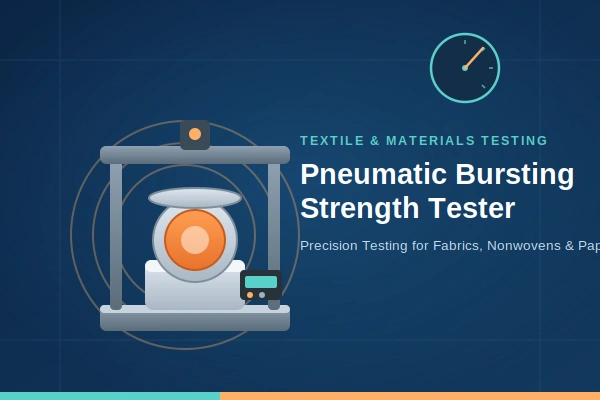
A pneumatic bursting strength tester is a laboratory instrument used to measure the maximum pressure a flat material can withstand before it ruptures. Instead of using hydraulic fluid to build pressure, the machine uses compressed air (or another gas) acting on a flexible rubber diaphragm. The sample is clamped tightly over the diaphragm, and as air pressure increases beneath it, the diaphragm expands and pushes against the material until the sample bursts. The instrument records the exact pressure — and often the expansion height — at the moment of failure.
This value, expressed in units such as kPa, MPa, or psi, is referred to as the “bursting strength” or “bursting pressure” of the material. It is one of the most widely used mechanical performance indicators in textile engineering, nonwoven manufacturing, paper testing, and flexible packaging quality assurance, precisely because it reflects a material’s overall structural integrity rather than strength in a single direction, unlike tensile or tearing tests.
Why Bursting Strength Testing Matters
Unlike tensile strength, which measures resistance to a pulling force along one axis, bursting strength testing applies multidirectional stress. This makes it especially valuable for materials that experience stretching and pressure from multiple directions in real use — think of a stretched fabric on a chair, an inflated packaging pouch, or a nonwoven hygiene product under body movement.
Bursting strength data helps manufacturers and quality teams:
- Verify that raw materials meet contractual or regulatory specifications before they enter production.
- Detect batch-to-batch inconsistencies caused by fiber quality, weave density, coating thickness, or lamination defects.
- Support product development by comparing how different fabric constructions, weights, or finishes perform under pressure.
- Provide objective, standardized data for customer complaints, certification audits, and third-party lab verification.
- Reduce costly field failures such as split seams, ruptured packaging, or torn medical and hygiene products.
Because the test is destructive, quick, and highly reproducible, it has become a routine part of incoming inspection and final product testing across the textile, nonwoven, paper, leather, and flexible packaging industries.
How a Pneumatic Bursting Strength Tester Works
The operating principle of a pneumatic burst tester is elegantly simple, even though the engineering behind a modern unit is quite sophisticated.
- Sample clamping – A flat specimen is placed over a circular test diaphragm and secured firmly by an upper and lower clamp ring. Even, uniform clamping pressure is essential to prevent slippage or air leakage during the test.
- Pressure build-up – Compressed air is fed beneath the diaphragm. As pressure increases, the diaphragm bulges upward and transmits that force evenly across the entire surface of the sample, simulating multidirectional stress.
- Continuous monitoring – A precision sensor tracks pressure in real time, while a displacement sensor (in advanced machines, a non-contact laser sensor) measures how far the diaphragm and sample expand.
- Rupture detection – At a certain point, the sample can no longer withstand the mounting pressure and bursts. The instrument instantly captures the peak pressure reading — this is the bursting strength — along with the expansion height at failure.
- Data recording and reporting – The result is displayed on-screen, logged, and can typically be exported or printed as a formal test report.
Because the entire cycle from clamping to rupture typically takes well under a minute, pneumatic testers are prized for high sample throughput in busy quality control labs.
Pneumatic vs. Hydraulic Bursting Strength Testers: What’s the Difference?
Most bursting strength testers fall into one of two categories: hydraulic and pneumatic. Understanding the distinction is key to selecting the right instrument.
Hydraulic bursting strength testers use pressurized liquid (usually glycerin or a similar fluid) to expand the diaphragm. Because liquids are essentially incompressible, hydraulic systems can generate very high, tightly controlled pressures with excellent accuracy. This makes them the preferred choice for dense, heavy-duty materials such as industrial canvas, tent fabrics, automotive textiles, technical laminates, and thick leather, where high bursting pressures are expected.
Pneumatic bursting strength testers, by contrast, use compressed air as the pressure medium. Air is compressible, which allows the system to build and release pressure very quickly, making pneumatic testers faster in cycle time and simpler in mechanical design. They excel with lighter and more breathable materials — knitted fabrics, nonwovens, tissue and packaging paper, thin films, and hygiene product components — where extremely high burst pressures aren’t typically required.
A practical way to summarize the decision:
| Factor | Hydraulic Tester | Pneumatic Tester |
|---|---|---|
| Best suited for | Dense, thick, industrial fabrics and leather | Light to medium fabrics, nonwovens, paper, film |
| Precision at high pressure | Excellent | Very good, ideal at lower to mid pressure ranges |
| Test speed | Moderate | Fast |
| Maintenance | More involved (fluid system) | Simpler, air-based, easier upkeep |
| Environmental profile | Uses hydraulic fluid | Uses air — cleaner and easier to dispose of |
| Relative cost | Higher | More economical |
For pressures below roughly 80 kPa, both technologies tend to produce comparable, reliable results, so the final decision often comes down to the nature of the materials you test most often, your required throughput, budget, and maintenance preferences. If your daily workload leans toward breathable apparel fabrics, nonwoven hygiene materials, paperboard, or flexible film, a pneumatic tester is generally the more practical and cost-effective option.
What Sets a Modern Pneumatic Bursting Strength Tester Apart
Bursting strength testers have existed for decades, but today’s instruments look nothing like the purely mechanical devices of the past. A genuinely modern pneumatic burst tester — the kind found in accredited textile, nonwoven, and packaging labs today — typically brings together several generations of engineering improvement:
High-precision, non-contact sensing. Rather than relying on mechanical rod-and-dial displacement systems that wear out over time, current-generation testers use non-contact laser displacement sensors to track diaphragm expansion. Because there’s no physical rod rubbing against components, the sensor experiences far less mechanical wear, stays accurate for longer, and makes swapping test cups faster and more convenient.
Servo-controlled, AI-assisted pressure delivery. Modern units pair a servo-pneumatic system with intelligent control logic to deliver very consistent, repeatable pressure ramp rates — an essential factor since test standards specify a target time-to-burst (commonly around 20 seconds). Being able to dial in and hold that target speed precisely, test after test, is what keeps results comparable across operators, shifts, and even different labs.
Automatic test-cup recognition. Because bursting strength tests are run using different test-cup sizes depending on the material and standard (common areas include 7.3 cm², 7.55 cm², 10 cm², 50 cm², and 100 cm²), a modern instrument can automatically detect which cup is installed and adjust its testing parameters accordingly — cutting down operator error and saving setup time.
Built-in international standards. Rather than requiring an operator to manually configure test parameters from scratch, current testers come preloaded with recognized standard test methods, letting users simply select the applicable standard and starting testing sample after sample with confidence that method parameters are correct.
Automatic safety features. A protective cover that lowers automatically during testing and lifts once the cycle is complete keeps operators safely away from the pressurized clamp area — an important consideration given that these instruments are frequently used in teaching labs and shared quality-control environments.
Adjustable clamping pressure. The ability to fine-tune clamping force to match different sample thicknesses and constructions helps prevent both slippage (which produces false low readings) and sample damage from over-clamping.
Digital connectivity and smart reporting. Many modern testers now connect to companion software or mobile applications via IoT, allowing technicians to view live test curves, adjust parameters remotely, export data, and even integrate results directly into a company’s LIMS or ERP system for paperless, end-to-end quality documentation. This is a significant step up from older machines that required manual transcription of results into spreadsheets.
Quiet, compact, and easy to maintain. Because pneumatic systems are inherently simpler than hydraulic ones, well-designed modern testers tend to be compact, quiet in operation, and straightforward to service — an advantage for smaller labs, teaching institutions, and facilities where floor space and noise levels matter.
Together, these upgrades mean today’s pneumatic bursting strength testers aren’t just “burst gauges” — they’re precision, data-connected quality instruments built for repeatability, traceability, and integration into modern digital quality management systems.
Applicable International Standards
Bursting strength testing is only useful if it’s performed consistently against recognized methods. Pneumatic bursting strength testers are generally built to comply with (or are configurable for) several major international and regional standards, including:
- ISO 13938-2 – Textiles — Bursting properties of fabrics — Pneumatic method for determination of bursting strength and bursting distension.
- GB/T 7742.2 – The Chinese national standard equivalent for pneumatic bursting strength testing of textiles.
- ASTM D3786 / D3786M – Standard test method for bursting strength of textile fabrics, diaphragm bursting strength tester method.
- AATCC 127 – Related standard sometimes referenced for water resistance and hydrostatic pressure testing, occasionally cross-referenced in bursting strength discussions.
Each standard specifies details such as acceptable test-cup sizes, sample conditioning requirements (typically around 20–21°C and 65% relative humidity), rate of pressure increase, and reporting format. A quality instrument allows operators to switch between these standards from the control interface without needing separate hardware for each method, which is particularly valuable for labs serving export markets with different regulatory requirements.
Typical Testing Procedure
While exact steps vary slightly by machine and standard, a typical pneumatic bursting strength test generally follows this sequence:
- Sample conditioning – Specimens are conditioned at standard atmospheric conditions (commonly 21±2°C and 65±5% relative humidity) for a specified period before testing, since temperature and humidity can significantly affect fabric and paper properties.
- Instrument setup – The operator powers on the tester, selects the relevant test standard, and inputs sample information such as material type, batch number, and desired number of specimens.
- Clamp and cup selection – The correct test cup and clamp size are installed based on the material type and required standard, and the machine may automatically recognize and configure itself accordingly.
- Sample loading – The conditioned specimen is placed flat and wrinkle-free over the diaphragm, then secured evenly by the clamping mechanism.
- Pre-run and protective cover engagement – A pre-test check compresses the sample gently and lowers the protective cover for operator safety.
- Pressurization and rupture – Air pressure is increased steadily until the sample bursts; the system captures peak pressure and expansion height in real time, often displaying a live pressure curve.
- Automatic reset – Once rupture is detected, the clamp releases and the protective cover retracts automatically.
- Report generation – The system compiles a report containing the bursting strength value, timestamp, standard used, and sample details, which can typically be saved, printed, or exported.
- Repetition for statistical reliability – Multiple specimens (often five or more per sample set, depending on the standard) are tested to calculate an average bursting strength and account for natural material variability.
Calibration and Maintenance Best Practices
Like any precision instrument, a pneumatic bursting strength tester needs periodic calibration and routine maintenance to keep results accurate and defensible for audits or certifications.
Pressure sensor calibration typically involves connecting a certified reference pressure gauge to the calibration port, applying a controlled pressure within a defined range, and adjusting the instrument’s internal reading to match the reference gauge. This should be done at scheduled intervals as defined by the lab’s quality system or the equipment manufacturer.
Height/displacement calibration ensures the expansion-height reading (used in standards that report bursting distension alongside pressure) remains accurate over time, particularly important with laser-based sensors, which, while more durable than contact-based rod systems, still benefit from periodic verification.
Diaphragm inspection and replacement is one of the most important routine maintenance tasks. The rubber test diaphragm is a consumable part that stretches thousands of times over its service life; a worn, cracked, or overstretched diaphragm will skew results and should be replaced promptly. Most modern machines guide operators through a step-by-step diaphragm replacement procedure directly on the control screen.
General good practice includes keeping the test head area clean and free of debris, avoiding touching or bumping the machine mid-test (which can affect pressure readings), storing test cups and clamps properly to avoid deformation, and running periodic repeatability checks using the same reference sample to confirm the instrument remains statistically consistent over time.
Consistent calibration and maintenance aren’t just good practice — they’re often a requirement for ISO/IEC 17025 lab accreditation and for any organization relying on burst-test data for regulatory submissions or customer specifications.
Industries and Materials That Rely on Bursting Strength Testing
Pneumatic bursting strength testers are used across a remarkably broad range of industries, including:
- Textile and apparel manufacturing – knitted fabrics, woven fabrics, activewear, and technical textiles, where burst resistance relates to durability during wear and stretching.
- Nonwoven production – hygiene products such as diapers, sanitary items, medical drapes, gowns, and wipes, where structural integrity under pressure is a critical safety and performance factor.
- Paper and packaging – corrugated board, kraft paper, paperboard, and paper sacks, where bursting strength (often expressed via the Mullen burst index) indicates how well packaging will survive handling, stacking, and shipping.
- Flexible plastic films – laminated films and pouches used in food, pharmaceutical, and consumer packaging.
- Technical and outdoor fabrics – umbrella fabric, tarpaulins, and other coated or laminated textiles that must resist pressure from wind, water, or physical contact.
Because the test method is standardized internationally, results are comparable across suppliers, factories, and countries — an important advantage for global supply chains and export-oriented manufacturing.
Choosing the Right Pneumatic Bursting Strength Tester
If you’re evaluating instruments for your lab, a few practical questions can guide the decision:
- What materials will you test most often? Lightweight fabrics, nonwovens, paper, and films are pneumatic testing’s sweet spot; extremely dense or thick industrial materials may call for a hydraulic system instead.
- What standards must you comply with? Confirm the instrument supports the specific standards your customers or regulators require (ISO 13938-2, ASTM D3786, GB/T 7742.2, etc.) and offers the corresponding test-cup sizes.
- How important is throughput? If your lab processes high sample volumes daily, features like automatic test-cup recognition and fast cycle times will meaningfully improve productivity.
- Do you need digital integration? Labs pursuing paperless quality systems or ISO 17025 accreditation benefit significantly from instruments offering direct data export, LIMS/ERP connectivity, and audit-ready reporting.
- What’s your maintenance capacity? Pneumatic systems are generally easier and less costly to maintain than hydraulic ones, which matters for smaller labs or teaching institutions with limited technical staff.
- What after-sales support and warranty are offered? Given that these are precision instruments used for critical quality decisions, reliable manufacturer support, spare parts availability (especially diaphragms and test cups), and a solid warranty are worth prioritizing.
Frequently Asked Questions
What does bursting strength actually measure? It measures the maximum pressure a material can withstand, applied evenly from multiple directions, before it ruptures — giving insight into overall structural durability rather than strength in just one direction.
Is a pneumatic tester accurate enough for demanding quality control work? Yes. Modern pneumatic testers with laser displacement sensing and servo-controlled pressure systems can achieve high measurement accuracy, generally suitable for pressures up to roughly 1.4 MPa depending on the model, making them well-suited to the vast majority of textile, nonwoven, paper, and film applications.
How often should the test diaphragm be replaced? There’s no universal fixed interval — it depends on testing volume and the pressures involved — but operators should visually inspect the diaphragm regularly and replace it as soon as signs of wear, cracking, or permanent deformation appear.
Can one machine test both fabrics and paper or film? Yes, provided the appropriate test cup, clamp, and standard settings are selected. Many modern pneumatic testers are explicitly designed to handle fabrics, nonwovens, foam, films, and paper-based materials.
Why does test-cup size matter? Different standards specify different test-cup diameters (common examples include 7.3 cm², 7.55 cm², 10 cm², 50 cm², and 100 cm²) because sample area affects how pressure is distributed and how comparable results are across labs following the same method.
Conclusion
The pneumatic bursting strength tester has evolved from a simple mechanical pressure gauge into a precision, data-connected quality instrument central to textile, nonwoven, paper, and packaging testing worldwide. Its core strength lies in speed, simplicity, and excellent performance on lightweight and medium-weight materials — paired, in modern instruments, with laser-based sensing, servo-controlled pressure delivery, automatic test-cup recognition, and digital reporting that fits neatly into today’s paperless, standards-driven quality systems.
Whether you’re running a teaching lab, an in-house QC department, or a third-party testing facility, understanding how these instruments work, which standards they support, and what features distinguish a modern unit from an outdated one will help you make a confident, well-informed equipment decision — and ultimately produce more reliable, defensible bursting strength data for every material that crosses your bench.
- You may love to read: Textile Lab Testing Equipment List | Fabric Testing Instruments/Machine