
Trims- Accessories Inspection
To ensure that the trims and accessories are going to be used in bulk production areas per the buyer’s acceptable quality standard and requirement, ensure that trims used in the bulk production are of an acceptable quality level, and minimize garment rejection due to trim defects. Trim inspection is very important for any garment manufacturer to claim trim supplier and get replaced by goods, trims, or compensation. After attaching trims to garments, the trim’s quality responsibility goes into the garments manufacturer’s hands. This article is about the Trims and Accessories Inspection Procedure of the Garments Industry.
The materials that are attached to the garment by sewing are called trims. The materials that are not attached to the garment by sewing, but are only used for garment finishing and packing, are called accessories. The objective of the inspection is to verify the quantity received against the packing list and to ensure that the items received are in accordance with the customer specifications.
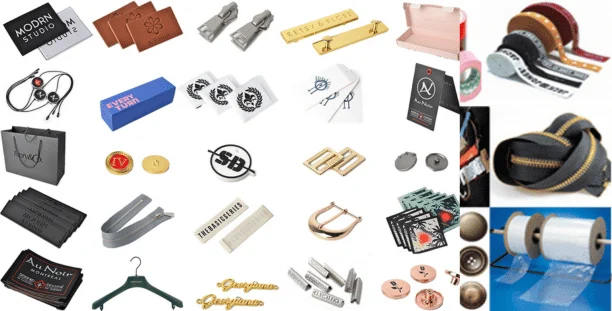
Trims- Accessories Inspection Procedure of the Garments Industry
After receiving the trims and accessories from the supplier, the store QC team will perform the following tasks:
- The merchandising department shall provide all information about the complete Bill of Materials (list of all fabrics and trims required), Packing List, Approved Trim Card, and Approved Sample of Each Trim in a Trim Card, which is signed and approved by the Merchandiser and the QC Manager.
- Trims Inspector shall follow the BOM (Material list), Packing list, and approved Trim Card with all details pertaining to each item.
- An inspection shall be done following the 1.5 AQL Standard. Shall select a random sample quantity as per the AQL Sample Chart.
- Each item shall be inspected within 72 Hours (3 Days) upon receipt in-house.
- Shall check each item comparing with the buyer-approved trim sample under the buyer-required light source and details specified in the trim detail sheet for its Color, Size, Construction, Material, Content, etc.
- In the event that the inspection fails for any item, you have to re-inspect 100% quantity to determine the percentage of rejects to inform the supplier of the need for replacement. The inspection report, tally filled with details of all observations and findings, shall be submitted to the Q.C. manager. The Q.C. manager shall notify the merchandiser immediately in case of any lot failure for any item.
- For each style, store all trims separately as follows:
- Trims not checked (To be kept) in one place.
- Trims checked and passed in one place.
- Trims Failed Inspection to be kept in the controlled Non-Conforming Raw-Materials area with Red Marking. And it needs to be made sure it doesn’t mix up with OK goods.
| AQL 1.5 Normal Inspection(Sample Sampling plan) | |||
| Total Order QTY. | Sample | Accept | Reject |
| 0-280 | 13 | 0 | 1 |
| 281-1200 | 32 | 1 | 2 |
| 1201-3200 | 50 | 2 | 3 |
| 3201-10000 | 80 | 3 | 4 |
| 10001-35000 | 125 | 5 | 6 |
| 35001-150000 | 200 | 7 | 8 |
| 150001-500000 | 315 | 10 | 11 |
| 500001-over | 500 | 14 | 15 |
The following things need to be taken care of during the Trims and Accessories Inspection:
- Product Safety – Trims are checked for product safety. If any trim has the potential to affect product safety (eg, sharpness, harmful to wear, metal, etc.) 10% will be checked 100% regardless of inspection method.
- Zippers – Zippers are checked for functionality, color, size, and any damage or missing parts.
- Labels – Main/Size/Care Labels – Checked against wording and print quality
- UPC Stickers are checked for UPC code and print quality.
- Buttons – Buttons are checked for size, color, and quality.
- Threads – Threads are checked for shade number, tax, and shade match to the sample.
- All trims/accessories are checked for color/shade under D65 light of the light box.
- Check sewing trims for color bleeding – All sewing trims are sewn to white fabric and washed as needed to check for any color bleeding.
Rejected trims/accessories should be kept in a separate designated area along with a report and returned to the supplier through the surveyor. Rejected goods must be reported to the store authorities every six (06) months. The trim inspection report format is easy to make.
Like the Fabric inspection at the incoming stage, the Trims and Accessories Inspection carries similar importance for the garment industry. Above all, the general instruction on the Trims and Accessories Inspection Procedure of the Garments Industry has to be followed for a good factory.
- Related contents: Trims and Accessories Inspection and Testing in the Apparel Industry