
Elmendorf Tearing Strength Tester: Principle, Working Procedure, Applications, and Importance in Textile Testing
The quality and durability of textile materials depend on many physical properties, and tearing strength is one of the most important among them. Fabrics used in garments, industrial textiles, technical textiles, packaging materials, and home furnishings are often exposed to sudden tearing forces during use. If the fabric cannot resist tear propagation, the product may fail quickly. That is why manufacturers and quality control laboratories use the Elmendorf Tearing Strength Tester to evaluate the tear resistance of fabrics, paper, plastic films, nonwoven materials, and similar products.
The Elmendorf tearing test is widely accepted in the textile and paper industries because it provides fast, reliable, and repeatable results. Understanding how this tester works is essential for textile engineers, quality inspectors, students, and laboratory professionals.
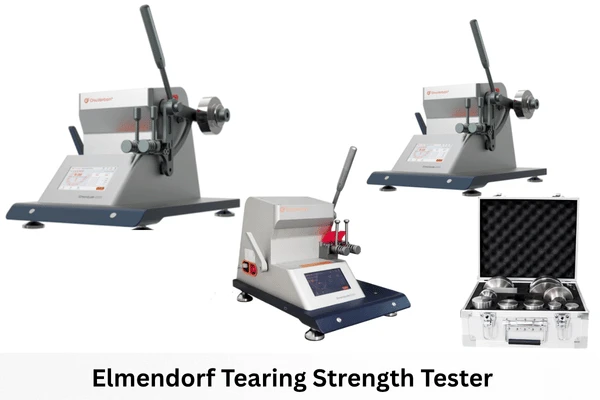
What is an Elmendorf Tearing Strength Tester?
The Elmendorf Tearing Strength Tester is a laboratory testing instrument used to determine the force required to continue tearing a fabric, paper, film, or other sheet material after the tear has already started.
The test measures the tearing resistance of materials by using a pendulum mechanism. A small cut is made in the specimen, and the pendulum tears the material further while measuring the energy absorbed during the tearing process.
The instrument is named after its inventor, Armin Elmendorf, who developed the testing principle to evaluate the tear resistance of paper materials. Later, the same principle became highly popular in textile testing laboratories.
Definition of Tearing Strength
Tearing strength refers to the resistance of a material against the propagation of an existing tear when force is applied.
In simple words, it measures how much force is needed to continue tearing a fabric after a cut or rupture has already occurred.
This property is extremely important because many fabrics do not fail suddenly under tensile load. Instead, they develop small cuts or holes during use, and those defects grow into larger tears. Fabrics with high tearing strength can resist the spread of damage and provide better durability.
Principle of Elmendorf Tearing Strength Tester
The working principle of the Elmendorf tearing tester is based on the energy loss of a pendulum during tearing.
A rectangular test specimen is partially cut beforehand. The specimen is then clamped in the instrument. When the pendulum is released, it swings downward and tears the specimen from the pre-cut point. The energy absorbed during tearing is proportional to the tearing strength of the material.
The instrument measures the amount of force or energy required to propagate the tear over a fixed distance.
The higher the energy absorbed, the greater the tearing resistance of the material.
Main Parts of Elmendorf Tearing Strength Tester
An Elmendorf tearing tester consists of several important components that ensure accurate testing.
1. Pendulum
The pendulum is the main moving component of the tester. It provides the tearing force required to tear the specimen.
2. Specimen Clamps
Two clamps hold the specimen securely during testing. One clamp remains fixed while the other moves with the pendulum.
3. Cutting Knife
A knife is used to create an initial slit or cut in the specimen before testing begins.
4. Scale or Digital Display
The scale or electronic display shows the tearing force or tearing energy absorbed during the test.
5. Calibration Weights
These are used for calibrating the pendulum and ensuring accurate measurements.
6. Specimen Holder
The specimen holder positions the fabric properly before testing.
Working Procedure of Elmendorf Tearing Strength Test
The testing procedure may vary slightly depending on the standard being followed and the machine model, but the general process remains almost the same.
Step 1: Specimen Preparation
The fabric specimen is cut into a specific size according to the testing standard. Usually, multiple specimens are prepared in both warp and weft directions.
Step 2: Conditioning
The specimens are conditioned under standard atmospheric conditions, generally at:
- Temperature: 20 ± 2°C
- Relative Humidity: 65 ± 2%
Conditioning ensures accurate and repeatable results.
Step 3: Making Initial Cut
A small slit is made in the specimen using the cutting knife provided with the machine.
Step 4: Mounting the Specimen
The specimen is placed between the clamps carefully so that the pre-cut slit aligns properly.
Step 5: Releasing the Pendulum
The pendulum is released manually or automatically. As it swings downward, it continues tearing the specimen.
Step 6: Reading the Result
The tearing force is displayed on the machine scale or digital screen. The value is recorded for analysis.
Step 7: Repeat Testing
Several specimens are tested, and the average tearing strength is calculated.
Test Standards for Elmendorf Tearing Strength Tester
Different international organizations have established standard methods for tear testing. Some of the most commonly used standards include:
- ASTM D1424 – Standard Test Method for Tearing Strength of Fabrics by Falling-Pendulum Type Apparatus
- ISO 13937-1 – Determination of Tear Force of Fabrics
- TAPPI T414 – Internal Tearing Resistance of Paper
- BS EN ISO 13937
- DIN Standards for tear testing
Following standard methods ensures consistency and global acceptance of test results.
Types of Materials Tested
The Elmendorf tearing tester is used for a wide range of materials, including:
- Woven fabrics
- Nonwoven fabrics
- Knitted fabrics
- Paper and paperboard
- Plastic films
- Packaging materials
- Technical textiles
- Medical textiles
- Geotextiles
- Leather substitutes
Importance of Tearing Strength in Textiles
Tearing strength is a critical quality parameter in textile manufacturing because fabrics often experience sudden stress during usage.
Durability Evaluation
Fabrics with good tear resistance last longer and perform better in practical applications.
Product Safety
Low tear strength may lead to sudden fabric failure, especially in industrial or protective clothing.
Quality Control
Manufacturers use tear testing to maintain consistent product quality.
Fabric Performance Assessment
Tear resistance helps determine whether a fabric is suitable for specific applications.
Customer Satisfaction
Consumers prefer products that resist tearing during daily use.
Factors Affecting Tearing Strength
Several factors influence the tearing strength of fabrics and materials.
Fabric Construction
Fabric weave, yarn density, and interlacement affect tear resistance significantly.
Yarn Type
Stronger and more elastic yarns generally provide higher tearing strength.
Fabric Weight
Heavier fabrics usually show greater resistance to tearing.
Finishing Treatments
Chemical finishes may improve or reduce tear strength depending on their nature.
Fiber Type
Synthetic fibers often exhibit better tearing strength than some natural fibers.
Direction of Fabric
Warp and weft directions may produce different tear strength values.
Moisture Content
Humidity and moisture can influence the tear properties of textiles.
Advantages of Elmendorf Tearing Strength Tester
The Elmendorf tester is widely preferred due to several advantages.
Fast Testing
The test can be completed quickly, improving laboratory efficiency.
Accurate Results
Modern digital models provide highly accurate measurements.
Easy Operation
The instrument is simple to operate with minimal training.
Standardized Method
The method is internationally recognized and accepted.
Suitable for Multiple Materials
The tester can evaluate various sheet materials beyond textiles.
Limitations of Elmendorf Tearing Strength Tester
Although highly useful, the instrument also has some limitations.
Not Suitable for Very Elastic Fabrics
Highly stretchable fabrics may not produce accurate results.
Initial Cut Dependency
Results depend partly on the quality and consistency of the initial slit.
Limited to Propagating Tear
The test measures tear propagation, not tear initiation.
Operator Influence
Improper specimen mounting may affect results.
Difference Between Tensile Strength and Tearing Strength
Many people confuse tensile strength with tearing strength, but both are different properties.
| Property | Tensile Strength | Tearing Strength |
|---|---|---|
| Definition | Resistance against pulling force | Resistance against tear propagation |
| Test Method | Tensile testing machine | Elmendorf tearing tester |
| Failure Type | Complete breakage | Growth of existing tear |
| Application | Overall fabric strength | Damage resistance |
A fabric may have high tensile strength but relatively low tearing strength.
Applications of Elmendorf Tearing Strength Tester
The tester is used extensively in many industries.
Textile Industry
Used for testing apparel fabrics, denim, workwear, upholstery fabrics, and technical textiles.
Paper Industry
Measures tearing resistance of paper, cardboard, and packaging materials.
Packaging Industry
Ensures durability of flexible packaging films and laminated sheets.
Automotive Industry
Tests interior textile materials and industrial fabrics.
Medical Textile Industry
Evaluates strength of surgical gowns, drapes, and nonwoven medical fabrics.
Research and Development
Used in laboratories for developing new materials and performance analysis.
Calibration and Maintenance
Regular calibration and maintenance are essential for accurate results.
Calibration
The pendulum and scale should be calibrated periodically using standard calibration weights.
Cleaning
Dust and lint should be removed from clamps and moving parts regularly.
Inspection
Check knife sharpness and clamp alignment frequently.
Lubrication
Moving mechanical parts should be lubricated according to manufacturer recommendations.
Proper maintenance increases instrument life and ensures reliable testing.
Safety Precautions During Testing
Laboratory personnel should follow safety measures while operating the tester.
- Keep fingers away from the pendulum path
- Handle cutting knives carefully
- Ensure proper specimen clamping
- Use the machine on a stable surface
- Follow operating instructions strictly
Modern Digital Elmendorf Tearing Testers
Modern tearing testers are more advanced than traditional mechanical models. Digital instruments offer:
- Touchscreen display
- Automatic pendulum release
- Electronic data storage
- Statistical analysis
- USB and computer connectivity
- Automatic result calculation
These features improve efficiency and reduce human error.
How to Interpret Test Results
Higher tear strength values indicate better resistance to tear propagation.
For example:
- Low tear strength fabrics may tear easily during use
- Medium tear strength fabrics are suitable for general garments
- High tear strength fabrics are ideal for industrial or heavy-duty applications
Results are often compared against customer requirements or international standards.
Why Elmendorf Tear Test is Popular
The Elmendorf tear test remains one of the most popular tear testing methods because it is:
- Quick
- Reliable
- Economical
- Standardized
- Easy to perform
- Suitable for many materials
Its long history of industrial use also makes it highly trusted worldwide.
Conclusion
The Elmendorf Tearing Strength Tester is one of the most important laboratory instruments used in textile and material testing. It helps manufacturers evaluate how well a material can resist the propagation of tears after damage has already started. This property is critical for ensuring product durability, reliability, and customer satisfaction.
From textile fabrics to paper, plastic films, and technical materials, the Elmendorf tearing tester plays a major role in quality control and product development. By following international testing standards and maintaining proper calibration, laboratories can obtain accurate and repeatable results.
As modern industries continue demanding stronger and more durable materials, the importance of tear strength testing will continue to grow. For textile engineers, students, researchers, and quality professionals, understanding the working principle and applications of the Elmendorf Tearing Strength Tester is essential for ensuring high-quality material performance.