
Introduction
Imagine buying a brand-new woolen sweater, wearing it twice, and then watching helplessly as tiny fiber balls begin forming on the surface. This frustrating phenomenon — known as pilling — is one of the most common quality complaints in the global textile and apparel industry. It affects consumer satisfaction, brand reputation, and retail returns across every product category, from casual knitwear to upscale upholstery. This is an article about the ICI Pilling and Snagging Tester and Box Test Method.
For manufacturers, suppliers, and quality assurance laboratories, preventing pilling issues before products reach consumers is not optional — it is essential. That is where the ICI Pilling and Snagging Tester, also known as the ICI Pilling Box Tester, plays a critical role.
This guide provides a thorough, technically accurate explanation of what the ICI Pilling and Snagging Tester is, how the ICI Pilling Box Test Method works, what international standards govern it, and why it remains one of the most trusted tools in global textile testing laboratories.
What Is Fabric Pilling?
Before understanding the testing machine, it is important to define what it measures. Pilling is the formation of small fiber balls — commonly called “pills” — on the surface of a fabric. These pills form when loose or protruding fibers on the fabric surface are subjected to friction during wear, washing, or everyday use. The friction causes the fibers to entangle with one another, twist together, and eventually consolidate into visible balls that cling to the fabric by a few remaining unbroken fibers.
According to ISO 12945-1, the three main stages of pilling are:
- Fuzzing — Protruding fiber ends form a hairy or fuzzy layer on the fabric surface.
- Pilling — The entangled fibers tighten into clearly visible balls (pills).
- Matting — Fibers tangle and pile up on the surface, causing loss of the original fabric texture.
Pilling is not equally distributed across fabric types. Fabrics constructed from strong synthetic fibers such as polyester and polyamide tend to hold pills attached to the surface longer, making them more visible. Fabrics with low-twist yarns or staple fiber yarns are more prone to fiber protrusion and early pill formation. Knitted fabrics, due to their inherently higher yarn mobility, show greater pilling tendency than woven structures.
What Is the ICI Pilling and Snagging Tester?
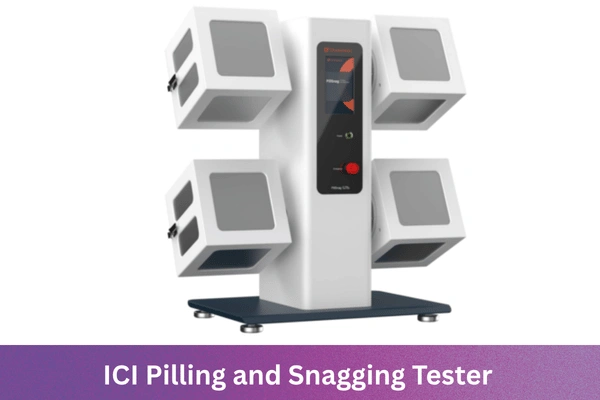
The ICI Pilling and Snagging Tester — widely referred to as the ICI Pilling Box or ICI Pilling Tester — is a textile testing instrument used to evaluate the propensity of woven and knitted fabrics to pill, snag, or fuzz under friction conditions. The instrument was originally developed by ICI (Imperial Chemical Industries) and has since become a globally standardized testing platform.
The machine works on a simple but highly repeatable principle: fabric specimens are mounted on polyurethane tubes and placed inside a rotating, cork-lined wooden box. As the box tumbles randomly at a controlled speed, the fabric specimens rub against each other and against the cork-lined walls without any external pressure applied. This simulates real-life, stress-free friction conditions that cause pilling during actual garment wear.
After a pre-set number of rotations, the specimens are removed and visually assessed against photographic reference standards to assign a pilling grade. The result gives manufacturers and quality control laboratories a reliable, reproducible measurement of a fabric’s pilling resistance.
Key Features and Components of the ICI Pilling Box Tester
Understanding the anatomy of the ICI Pilling and Snagging Tester helps clarify how the test achieves its precision and repeatability.
1. The Pilling Box (Testing Chamber)
The cubic pilling test box has internal dimensions of 235 ± 2 mm before lining is applied. All internal surfaces of the box are lined with cork jointing material of 3.2 ± 0.4 mm thickness. This cork lining provides the frictional surface against which the fabric specimens tumble. The box rotates at a constant speed of 60 ± 2 revolutions per minute (rpm) about a horizontal axis passing through the centers of two opposite faces. One side of the box is removable to allow loading and unloading of specimens.
Different box designs — including square boxes and octagonal or round boxes — are available depending on the specific standard being followed. For snagging tests, an exchangeable octagonal drum equipped with snagging points can replace the standard cubic box.
2. Polyurethane Sample Tubes
Fabric specimens are mounted on polyurethane carrier tubes with specific dimensions: external diameter of 31.5 ± 1 mm, length of 140 ± 1 mm, and wall thickness of 3.2 ± 0.5 mm, with a weight of approximately 52.25 ± 1 g. These tubes give the specimen a cylindrical form, allowing it to tumble freely inside the box without folding or creasing, which would otherwise give inconsistent results.
3. Drive System and Cycle Counter
The ICI Pilling Tester uses a universal drive system available in 2-position, 4-position, 6-position, or even 9-position configurations, allowing multiple samples to be tested simultaneously. An electronic digital counter tracks and displays the number of revolutions, automatically stopping the machine when the preset cycle count is reached. This eliminates operator error and ensures test repeatability.
4. Cork Lining — A Critical Consumable
The cork lining inside the box is critical to achieving consistent test results. Cork linings must be inspected regularly and replaced when they become obviously damaged, soiled, or worn in a way that could alter their frictional properties. The standard recommends periodic calibration checks on the pilling box to verify consistent performance across testing cycles.
5. Snagging Drum (Optional Accessory)
For snagging tests — which assess a fabric’s tendency to catch or snag on rough surfaces — an optional octagonal drum fitted with snagging points replaces the cubic box. This accessory allows the same machine to function as both a pilling tester and a snagging tester, making it a dual-purpose instrument.
International Standards Covered by the ICI Pilling Box Test
One of the most significant advantages of the ICI Pilling and Snagging Tester is its compliance with a wide range of international textile testing standards. Different markets and retail brands specify different standards, and the ICI Pilling Box is uniquely positioned to fulfill most of them:
| Standard | Description |
| ISO 12945-1 | Textiles — Determination of fabric propensity to surface pilling, fuzzing, or matting — Pilling box method |
| BS EN ISO 12945-1 | British/European adoption of ISO 12945-1 |
| BS 5811 | British Standard for the pilling and fuzzing of knitted fabrics |
| GB/T 4802.3 | Chinese national standard for fabric pilling using the pilling box method |
| JIS L1076 / JIS L1058 | Japanese standards for pilling and snagging of woven and knitted fabrics |
| IWS TM152 | International Wool Secretariat method for wool textiles |
| NEXT TM19 | Next Retail standard for pilling assessment |
| BS 8479 | British Standard for snagging propensity — rotating chamber method |
| M&S P18 / P18A / P18B / P21A | Marks & Spencer-specific testing protocols |
The machine can be configured with different box types to accommodate multiple standards on the same equipment, making it an efficient investment for multi-standard testing laboratories.
ICI Pilling Box Test Method: Step-by-Step Procedure
The ICI Pilling Box test method is a carefully standardized procedure. Each step is designed to control variables that could otherwise affect the result. Below is a comprehensive walkthrough of the standard methodology as specified under ISO 12945-1 and related standards.
Step 1: Sample Conditioning
Before cutting or testing, fabric specimens should be conditioned in a standard atmosphere — typically 20°C ± 2°C temperature and 65% ± 4% relative humidity — for a minimum of 24 hours. This ensures that the fiber moisture content is in equilibrium, which directly affects frictional behavior and pilling tendency.
Step 2: Pretreatment (Where Required)
If the test specification requires pretreatment, the fabric samples may be laundered or dry-cleaned using a method agreed upon between the testing parties. Pretreatment is strongly recommended when the fabric carries residual lubricants, finishing agents, or surface treatments that could interfere with the friction dynamics inside the pilling box. Pretreating protects the cork lining and the polyurethane tubes from contamination, which would produce inconsistent results over time.
Step 3: Specimen Cutting and Preparation
Four test specimens are cut from the fabric sample, each measuring 125 mm × 125 mm. Care should be taken to ensure that no two specimens share the same warp and weft yarns — this distributes the sampling across the fabric and gives a more representative result. An additional specimen of the same size is cut from the same fabric to serve as an untested reference or comparison sample for the grading stage.
Both the reverse side and the longitudinal direction of each specimen should be clearly marked.
Step 4: Specimen Mounting on Tubes
- Two specimens are folded inward along the longitudinal (warp) direction with the face side inside.
- The other two specimens are folded inward along the lateral (weft) direction, also face side inside.
- Each folded specimen is sewn with a sewing machine at 12 mm from the edge, creating a fabric tube or “sample cell.” The stitch density should be consistent to ensure a uniform seam.
- The sewn specimens are turned inside-out so that the face (right side) of the fabric is on the outside.
- Each sample cell is then slipped onto a polyurethane tube, with the ends trimmed 6 mm from both ends of the tube.
- PVC tape or adhesive is used to fix the ends of the fabric securely onto the polyurethane tube.
This mounting process is critical: inconsistent mounting can cause specimens to shift during tumbling, compromising the integrity of the result.
Step 5: Cleaning the Pilling Box
Before loading specimens, the pilling box must be cleaned of any residual fibers or debris from previous tests. Light brushing, vacuum cleaning, or a compressed air gun can be used to clear the box interior. The cork linings should be visually inspected for wear or damage and replaced if necessary.
Step 6: Loading and Running the Test
All four prepared specimens (on their polyurethane tubes) are placed into the same pilling box. The lid is firmly closed and locked. The cycle counter is set to the required number of revolutions:
- 7,200 revolutions — Recommended for coarse or woolen (worsted-spun) fabrics.
- 14,400 revolutions — Recommended for fine or worsted fabrics, as well as synthetic blends that pill more slowly.
Some standards may specify different revolution counts depending on the fabric type and end-use application. Once the counter is set, the machine is started. At 60 ± 2 rpm, a 7,200-revolution test takes approximately 2 hours, and a 14,400-revolution test takes approximately 4 hours.
Step 7: Specimen Recovery
When the machine automatically stops at the pre-set cycle count, the specimens are removed from the box. The sewn seam is carefully removed, the specimen is unfolded, and any loose threads are cleared. The specimen is then allowed to relax in the conditioned atmosphere before visual assessment.
Step 8: Visual Assessment and Grading
The most important stage of the test is the visual grading. The tested specimen and the untested reference specimen are placed side-by-side on the viewing panel of a pilling assessment viewer (also called a pilliscope or rating box). The rating box should be placed in a darkened room to control ambient lighting conditions, with the specimens positioned in the longitudinal (warp) direction of the fabric.
The grading is conducted using photographic reference standards — a set of standard photographs or fabric replicas showing varying degrees of pilling, numbered from Grade 1 to Grade 5:
| Grade | Description |
| 5 | No change — No pilling, fuzzing, or surface change |
| 4 | Slight change — Slight fuzzing or isolated pills |
| 3 | Moderate change — Moderate pilling over the fabric surface |
| 2 | Significant change — Distinct and dense pilling |
| 1 | Severe change — Heavy, dense pilling covering most of the surface |
If the tested specimen falls between two grades, a half-grade (e.g., 3-4 or 2-3) may be recorded. The assessment is typically performed by two trained assessors independently, and the average of their grades is reported. The final test report should note whether any pretreatment was applied, the number of revolutions used, and any observable anomalies in the specimen surface.
Pilling vs. Snagging: Understanding the Difference
Although the ICI Pilling and Snagging Tester covers both phenomena, pilling and snagging are distinct fabric defects:
- Pilling involves the entanglement of fibers into balls on the fabric surface. It results from friction against itself or other surfaces during normal use.
- Snagging involves a single yarn loop being pulled out of the fabric structure by a sharp or rough object, creating a loop or pulled thread visible on the surface. This is especially common in loosely constructed knitted fabrics.
The ICI tester addresses snagging through the optional octagonal rotating drum fitted with snagging spikes. The drum catches individual yarns and pulls them, simulating the effect of a rough surface like Velcro, jewelry, or rough furniture edges on the fabric.
Fabric Types Suitable for ICI Pilling Box Testing
The ICI Pilling and Snagging Tester is suitable for a broad range of fabric types, including:
- Woven fabrics — plain weave, twill, satin, and their variations in natural and synthetic fibers
- Knitted fabrics — single jersey, interlock, rib, and warp-knitted structures
- Wool and wool-blend fabrics — where pilling is historically most common
- Synthetic fiber fabrics — polyester, nylon, acrylic, and their blends
- Home textile fabrics — sheets, duvet covers, sofa upholstery, and pillowcases
- Technical and functional textiles — outdoor gear, workwear, and automotive interiors
- Fleece and napped fabrics — which tend to fuzz and pill rapidly
The test is especially valued for evaluating wool knitted and wool-like knitted fabrics, where pilling is a primary quality concern and a key factor in consumer purchase decisions.
Factors That Affect Pilling in Fabric
Understanding the root causes of pilling helps manufacturers make design and production decisions that reduce pilling tendency before testing even begins:
1. Fiber Type and Strength: Synthetic fibers such as polyester, nylon, and acrylic have high tensile strength, meaning the pills that form stay attached to the fabric surface longer, making pilling more visible. Natural fibers like wool and cotton produce pills too, but the pills detach more easily due to lower fiber strength.
2. Yarn Twist: Yarns with higher twist have better fiber cohesion, so fewer fibers protrude and pill. Low-twist yarns and soft-spun yarns are inherently more prone to pilling.
3. Fabric Structure: Loosely constructed fabrics — whether woven or knitted — allow more yarn mobility, which increases pilling. Tightly woven or tightly knitted structures resist pilling better.
4. Fabric Density: Higher thread counts or tighter loop formations reduce the space for fiber movement, lowering pilling risk.
5. Finishing Treatments: Anti-pilling finishes, singeing, and cropping can significantly reduce fiber protrusion and pilling tendency. However, these effects may diminish after repeated washing.
6. Fiber Length: Fabrics made from shorter staple fibers have more fiber ends protruding from the yarn surface, increasing pilling risk compared to long-staple or continuous filament fabrics.
ICI Pilling Box vs. Martindale Pilling Test: Key Differences
The two most commonly referenced pilling test methods in global trade are the ICI Pilling Box Method (ISO 12945-1) and the Martindale Method (ISO 12945-2). While both assess fabric pilling, they differ significantly in their approach:
| Parameter | ICI Pilling Box (ISO 12945-1) | Martindale Method (ISO 12945-2) |
| Friction principle | Random tumbling, no pressure applied | Rubbing under defined pressure in figure-8 motion |
| Stress type | Stress-free random friction | Pressure-applied abrasion |
| Best suited for | Knitted and woolen fabrics | Woven fabrics and upholstery |
| Market emphasis | European (especially UK/Germany) | European and global upholstery markets |
| Key standard | ISO 12945-1, BS 5811 | ISO 12945-2, ISO 12947-2 |
| Test duration | 2–4 hours | Variable (by cycle count) |
Most quality assurance programs use both methods to build a comprehensive picture of fabric durability, since they simulate different types of real-world wear.
Applications of the ICI Pilling and Snagging Tester in Industry
The ICI Pilling Box Tester is used across several sectors of the textile supply chain:
Garment Manufacturing and Brand Compliance
Retail brands including major European fashion retailers require knitted garments to achieve a minimum of Grade 3–4 under ISO 12945-1 before they can be sold. Quality control departments use the ICI Pilling Box to verify fabric compliance before production, during fabric approval stages, and in final product auditing.
Yarn and Fiber Development
Yarn spinners and fiber manufacturers use pilling test data to develop anti-pilling formulations, optimize twist levels, and compare the performance of different fiber blends. This data supports new product development and technical marketing claims.
Home Textiles and Upholstery
Bedding manufacturers, furniture upholstery producers, and home textile brands use the ICI Pilling Box to verify that their fabrics can withstand repeated friction from normal domestic use without deteriorating in appearance.
Technical and Functional Textiles
Workwear and outdoor performance fabric manufacturers use pilling tests to assess durability under demanding conditions. A fabric rated Grade 4 or 5 after intensive testing provides confidence in extended product life.
Third-Party Testing Laboratories
Independent testing laboratories use the ICI Pilling and Snagging Tester to provide certification services to brands, retailers, and importers who require verifiable test data for trade compliance, buyer audits, and regulatory requirements.
Maintenance and Calibration of the ICI Pilling Tester
Proper maintenance of the ICI Pilling Box Tester is essential for consistent and reliable results:
- Cork lining inspection: The cork linings should be inspected before every test session and replaced when visibly worn, compressed, or contaminated. Damaged cork surfaces alter the friction conditions and produce inconsistent results.
- Speed verification: The rotational speed of the pilling box should be checked regularly with a tachometer and confirmed to be within the specified range of 60 ± 2 rpm.
- Polyurethane tube condition: Sample tubes should be inspected for surface wear, deformation, or surface contamination. Worn tubes may not provide a consistent friction surface and should be replaced.
- Box cleaning: The interior of the box should be cleaned between test runs to prevent fiber contamination from previous specimens from affecting subsequent results.
- Counter calibration: The electronic counter should be verified periodically to ensure it accurately counts and stops at the specified revolution count.
How to Choose the Right ICI Pilling and Snagging Tester
When selecting an ICI Pilling Box Tester for your laboratory or production facility, consider the following factors:
1. Number of Test Stations: Models range from 2 to 9 simultaneous test positions. Laboratories with high throughput requirements benefit from 4- or 6-station configurations that test multiple specimens simultaneously.
2. Box Interchangeability: Look for machines that can accept both square cubic boxes and octagonal snagging drums without requiring separate instruments, since this expands the range of standards you can fulfill.
3. Compliance with Applicable Standards: Confirm that the machine’s specifications (box dimensions, rotational speed, cork lining thickness) comply with the specific standards required by your customers or buyers.
4. Counter and Control System: An electronic LCD display with preset cycle counting and automatic stop functionality reduces operator dependency and increases test reliability.
5. Build Quality and Motor Reliability: A high-quality motor produces lower operational noise, longer service life, and more consistent rotational speed over thousands of testing cycles.
6. Consumables Availability: Check the availability and cost of replacement cork linings and polyurethane tubes, as these are regular consumables in any pilling testing operation.
Interpreting and Reporting ICI Pilling Test Results
Accurate interpretation and clear reporting of pilling test results is as important as performing the test itself. Here is how to approach the reporting stage professionally:
- State the standard followed (e.g., ISO 12945-1:2020) and the number of revolutions used.
- Record the grade for each of the four specimens individually, and calculate the average grade rounded to the nearest half grade.
- Note any pretreatment applied before testing (washing cycles, dry-cleaning, or no pretreatment).
- Record observations of specific surface changes beyond the numerical grade — such as fiber fuzzing only, pill formation plus fuzzing, or matting.
- Compare against acceptance criteria — most retail buyers specify a minimum grade, and the report should clearly indicate pass or fail status.
The combination of quantitative grading and qualitative surface observation provides the most complete picture of fabric pilling behavior and supports informed decisions at both the design and procurement stages.
Frequently Asked Questions About the ICI Pilling and Snagging Tester
Q: What is the difference between the ICI Pilling Box and a random tumble pilling tester? A: Both use tumbling motion, but the ICI Pilling Box is primarily aligned with European testing standards (ISO, BS, JIS), while random tumble pilling testers (such as the ASTM D3512 method) are more commonly specified in the North American market. The friction mechanisms and box designs differ between the two.
Q: How often should the cork lining be replaced? A: Cork linings should be replaced when visibly worn, stained, or damaged. Under regular laboratory use, replacement typically occurs every several hundred test hours, though frequency depends on the fabrics being tested and cleaning practices.
Q: Can the ICI Pilling Box test be used for water-repellent or coated fabrics? A: It can be used, but pretreatment (such as washing) is recommended to remove surface treatments that may interfere with friction and produce artificially better pilling grades than would be observed in real use.
Q: What is the minimum acceptable pilling grade for apparel? A: Most major retail brands require a minimum grade of 3–4 (slight to no change) under ISO 12945-1. For premium wool garments, many brands specify Grade 4 or above.
Q: Is the ICI Pilling Tester the same as the Martindale Tester? A: No. They are different instruments using different mechanisms. The ICI Pilling Box uses random tumbling friction without applied pressure, while the Martindale uses a figure-8 rubbing motion under a defined load. Both are used for pilling assessment but cover different fabric types and wear simulations.
Conclusion: The ICI Pilling Box Tester as a Cornerstone of Textile Quality Assurance
The ICI Pilling and Snagging Tester and the ICI Pilling Box Test Method together represent one of the most time-tested, globally recognized tools in textile quality control. Their ability to simulate real-world, stress-free friction conditions — and to do so in a repeatable, standardized way — has made them indispensable in laboratories serving apparel brands, textile mills, retail buyers, and certification bodies across every major market.
From the preparation of 125 mm × 125 mm test specimens, through the careful mounting on polyurethane tubes, to the tumbling at 60 rpm inside cork-lined boxes, and finally the visual grading against photographic standards — every element of the test is designed to deliver reliable, comparable results that reflect how real fabrics behave in real-world use.
Whether your laboratory serves the fast fashion sector or luxury wool knitwear brands, whether you test home textiles, technical fabrics, or automotive interiors, the ICI Pilling Box Tester provides the foundational data needed to make confident quality decisions, protect brand reputation, and deliver products that consumers trust.
Understanding this instrument in depth — its components, its operating standards, its sample preparation protocols, and its grading methodology — positions quality professionals, fabric technologists, and laboratory managers to use it to its fullest potential and interpret its results with accuracy and confidence.