
Nylon is an important synthetic material for industrial purposes. It has many variants like Nylon 66, Nylon 6, Nylon 5,10, Nylon 6,12, Nylon 11, etc. What to choose, a little bit confusing, right? Find out the differences between Nylon 6 and Nylon 66 right below!! You will get to know about nylon 6, nylon 6,6, along with their application area in brief in this article. What are the Differences between Nylon 6 and Nylon 66 properties?
For High mechanical damping ability, good sliding properties, excellent wear resistance, good electrical insulating properties, and good resistance to high-energy radiation, Nylon becomes incredibly popular for different industrial purposes.
A glance at the difference between Nylon 6 and Nylon 66 Properties
Basically, the main difference between Nylon 6 and Nylon 66 is in their chemical structure. Both of them are popular for their durability and lightweight properties. Nylon 6 is formed from Caprolactam by open-ring polymerization, having a lower melting point.
Whereas Nylon 66 is formed from hexamethylene diamine and Adipic acid through a condensation polymerization reaction, it has a higher melting point. The latter property makes it suitable for high-performance industrial use.
It provides good insulation and damping properties. Toughness, stiffness, and hardness are the characteristics of nylon 6. It has a lustrous finish, and it exhibits good dye affinity.
Uses of Nylon 6
- Hosiery
- Industrial yarn
- Upholstery
- Heavy-duty fabric
- Toothbrush fiber
Uses of Nylon 66
Its micro denier form is mostly used in apparel such as industrial workwear. Heavy denier is used in-
- Tire cord
- Automotive airbags
- Parachutes
- Carpets
- Nylon Drawn Textured Yarn
As Nylon 6 is a bit more lustrous than Nylon 66, it is suitable for radiator grilles, stadium seats, or firearm components where we need an attractive lustrous finish.
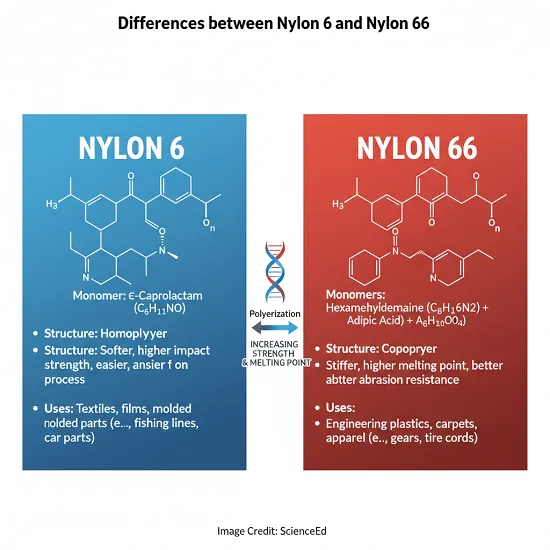
Differences between Nylon 6 and Nylon 66 in detail!!
Find out the Differences between Nylon 6 and Nylon 66 properties below:
| Topics | Nylon 6 | Nylon 66 |
| No. of carbon atoms in structure | No of carbon atoms are 6. It represents that it has 6 carbon atoms in the backbone of its chain | Nylon 66 has two 6 numbers. It indicates the number of carbons in the acid and ammine residues. So it has 12 carbon atoms. |
| Requirement of monomer | Only one monomer is required | Two monomers are required |
| Monomer used | Caprolactam | Hexa-mythelene di-amine and Adipic acid |
| Polymerization technique | It is known as poly-caprolactam which is formed by open ring polymerization | This polyamide is formed by condensation polymerization |
| Melting point | Lower (215-220°C) | Higher (250-265°C) |
| Crystallinity | Less | More |
| Water absorption rate | High | Low |
| Chemical resistance to acid | Poor | Good |
| Heat deflection temperature | Low | High |
| Moisture regain | 4-4.5% | 4-4.5% |
| Chemical name | Poly (6-aminocaproic acid) | Poly [Immino (1,6-dioxohexamythelene)immio hexamythelene] |
| Density | 1.15 g/ml | 1.2 g/ml |
| Degree of polymerization | 200 | 60-80 |
| Recyclability | More recyclable than nylon 66 | Less recyclable than nylon 6 |
| Tensile strength | 6.2 × 10⁴ kPa | 8.3 × 10⁴ kPa |
| Glass transition temperature (Tg) | Dry – 60Tg reduces with the increase in moisture content | Dry – 70 |
| Molecular mobility | High | Low |
| Color fastness | Less than nylon 66 | Better |
| Dye affinity | Great dye affinity | Shows less dye affinity than nylon 6 |
| Temperature resistance | Less than nylon 66 | Better |
| Stain clean-ability | Low | High |
| Resilience | Low | high |
| Mold shrinkage | Low | More |
| Heat setting at hot air | 190°C | 205°C |
| Internal structure | Less compact | More compact |
| Heat setting at steam | 120°C | 135°C |
| Application | Radiator grilles, stadium seats or firearm components | Friction bearings, battery modules, luggage and conveyor belts |
| Elastic modulus | Lower | Higher |
| Elastic recovery | Better | Lower than nylon 6 |
| Luster | More lustrous surface | Less lustrous surface |
To Sum Up!!
So, what should you choose for your specific purpose? Both Nylon types are the same, and changes happen in the chemical structure. You will clearly get your answer if you understand the differences between nylon 6 and nylon 66.
- You may love to read: Differences Between Spinning and Weaving