A jacket is a must-have garment in the winter season. Temperatures less than fifteen degrees Celsius are beyond the tolerance of human beings without warm clothes. In European countries, 17 to 19 degrees Celsius is the perfect temperature to wear summer jackets. From men to women, from kids to youngsters, everyone has to wear jackets to protect themselves in cold weather. All over the world, the demand for jackets is always increasing with different colors, styles, and designs. Many more items are required to construct a warm jacket. So, without wasting time, here we can start with the common items required for a jacket to construct. In this article, we are going to learn about the different parts of a Jacket.
A jacket is functionally an outerwear and workwear item of heavy clothing. Different Parts of a Jacket and how it is made are given below:
What are the Different parts of a jacket?
Here are the different Parts of a jacket, shown in parts by the materials used during the jacket-making process:
Main Fabric Parts
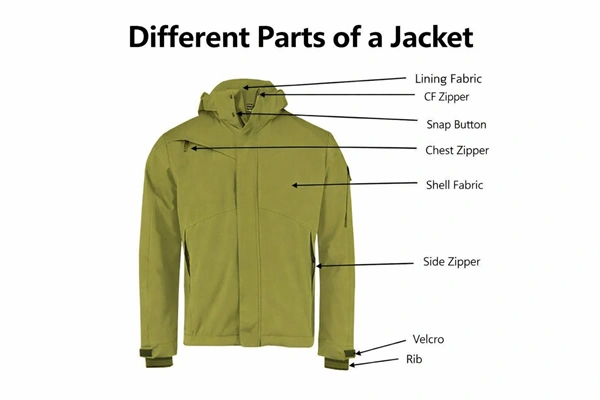
1. Shell – The top fabric of a jacket is called shell fabric. This covers the full body of the jacket. The GSM of the shell part is generally higher than the lining part. Two/three shell parts can be used in a jacket. It is typically made of 100% polyester.
2. Lining – Under the top fabric, another fabric is used, which is called the lining fabric. The GSM of the lining fabric is usually lower than that of the shell fabric. Two/three lining parts can be used in various types of jackets. Most of the lining is made of 100% nylon. It is sometimes called taffeta. Taffeta is made of man-made fibers like polyester or nylon, and sometimes silk, which is more expensive. They are called 240T, 380T, etc. Here, T is the sum of the warp and weft yarns in one square inch of fabric.
Sewing and Trims Items
4. Sewing Threads – Sewing threads of count 20/2, 40/2, 50/2, 50/3 etc. are used for the jacket construction.
5. Snap Button – A metal snap button is used for jacket construction. Most have 3 to 4 parts with plastic washers used with a snap button to attach them to the fabric. It is used in the center front part or in the pocket flap of a jacket.
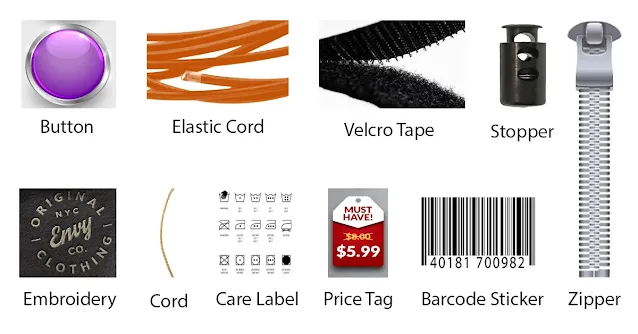
6. Button – Plastic or metal buttons may be used in the center front part or in the pocket parts of a jacket.
7. Elastic Cord – An elastic cord or bungee cord is used in the collar part, in the bottom part, or in the sleeve/cuff part of a jacket.
8. Elastic – Elastic may be used in the cuff part or in the bottom part of a jacket. Depending on the design, the size and width of the elastic may vary from each other. Mostly, 2 to 5 cm elastic is used for jackets.
9. Velcro tape – Velcro tape is used in the cuff part to cover the hand according to the comfortable size. It is also used in the pocket flap part for covering.
10. Stopper – The stopper is used with an elastic cord to control the length. It may be made of metal or plastic. One- and two-hole stoppers can be used for jackets.
11. Eyelet – Eyelet is used to pass the elastic cord easily. Generally, three parts are available with an eyelet. It may be made of metal or plastic. Depending on the color construction of the elastic cord, the color of an eyelet may change. Black, gunmetal, and white are common colors for an eyelet. The hole size may differ according to the cord size.
12. Crush Fiber – Crush fiber is used to make the jacket softer and more comfortable to wear. It increases the puffiness of a jacket. Hence, it is one of the most common items of a winter jacket because it holds the body’s temperature of the body.
13. Padding – Padding also works as crushed fiber that helps hold the body temperature to feel warmer. GSM of padding varies according to the design of the jacket. 120 to 240 GSM padding is mostly used for warm jackets. The higher the GSM, the softer and warmer.
14. Scrim – Scrim is used to cover the crushed fiber. It is a thin paper with 10/20 GSM. It can be black or white. The crushed fiber may be used on both sides or on one side of the crushed fiber.
15. Needle punch – Needle punch is used to give support to any part of the jacket. It is mostly used in the pocket area, collar, and cuff areas.
16. Fusing/Interlining – Fusing is a lower GSM thin fabric that is used with a needle punch or lining part to cover the sewing and give support.
17. Zipper – Zippers may be of different sizes and different types. Depending on the design, it is used. It may be made of plastic or metal. Vislon zipper is mostly used in the center front area, and chain zipper is used in the pocket or sleeve area. Special zippers are different (waterproof zippers) and are used in swimwear and rainy wear, as well as in waterproof jackets.
- CF Zipper-Center front zipper is used to open or close the front body part of a jacket.
- Pocket Zipper- A pocket zipper is used to open or close the pocket part of a jacket.
- Sleeve Zipper- A sleeve zipper is used to open or close the sleeve part of a jacket.
- Hood Zipper-Hood zipper is used to open or close the hood part of a jacket.
18. Heat Seal / Print – Different types of heat print may be used on a jacket. Generally, a heat print of rubber/semi-rubber is used.
19. Embroidery – Embroidery is used according to the design and requirements of the buyer. It may be ready-made or need to be stitched in the required part.
20. Piping cord – It is used to give support to any part, such as the cuff or bottom of a jacket, to prevent that part from being curved easily.
21. Main Tag – A tag used to display the name or group of buyers or brand names. Sizes may or may not be included.
22. Main Label – The main label displays the name of the brand or buyer and may also display the sizes.
23. Size Label – The size label refers to the different sizes of a jacket. It may be stitched in the back yoke part or in the inner lining part of a jacket.
24. Patch label – Patch labels may be made of rubber, silicone, or leather. It is used to show the brand name, or sometimes the buyer’s name.
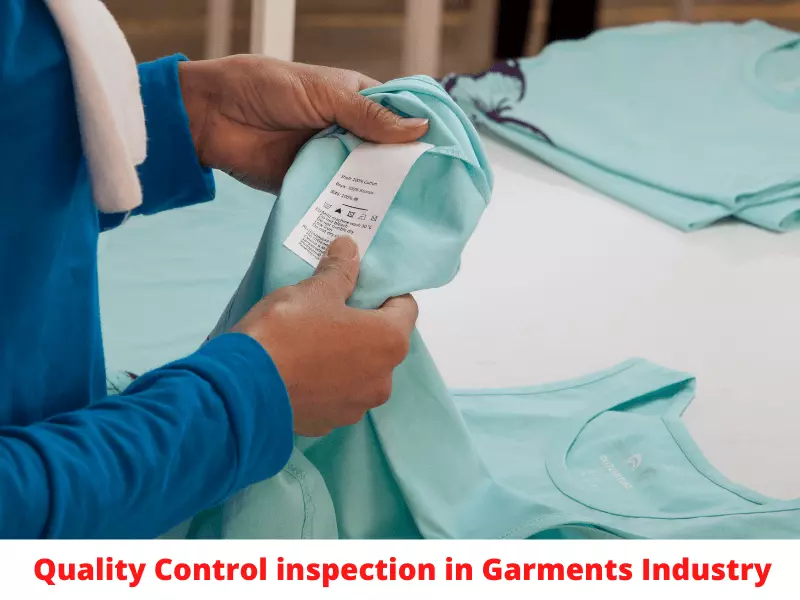
25. Care Label – All the required care and washing instructions are written on it. Hot/cold/dry washing and ironing temperature grades, and fabric constructions may be written on it.
Finishing/Packing Accessories Items
26. Loop lock – The loop lock is used for adding other hang tags or stickers to it. They may be made of plastic or synthetic fabrics with attached plastic.
28. Hang tag – A hang tag is a kind of tag that displays the brand name, the color, or the size of a jacket.
27. Price tag – The price tag is used to show the price of a jacket.
28. Polybag – A polybag is used for the final packing of the jacket. A mark may be written on it, to be followed by mentioning the raw materials required to make it.
29. Tissue Paper – Tissue paper may be used in packing to resist friction among the metal parts and to give priority to the softness of the jacket.
30. Barcode Sticker – A sticker displaying a barcode or hidden code used to identify a jacket.
31. Carton sticker – The carton sticker displays the brand name, quantity, and hidden code of the jackets in a carton. A barcode may be on it to display the hidden code.
32. Carton – The carton is used to keep the produced goods and ship them to the buyer’s address. The carton size may differ according to the size of the goods. In cartoning, a ratio may or may not be followed. Solid size/color may also be instructed by the buyer.