
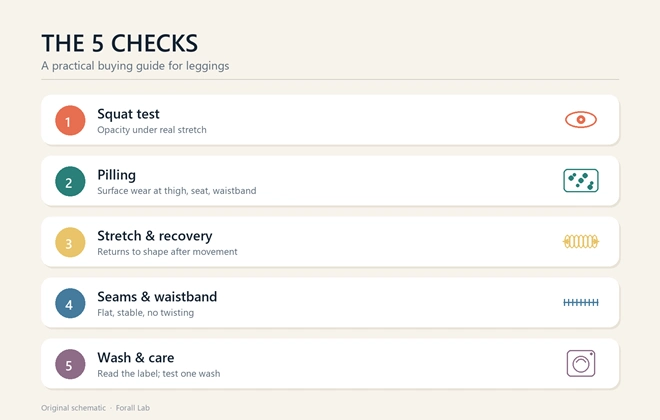
Two pairs of leggings can carry the same fiber label and still behave differently after a month. One keeps its shape; the other bags at the knee, pills between the thighs, or turns transparent in a squat. The difference is rarely one number on the tag. It comes from the yarn, the knit structure, the finishing, the sewing, and the way the fabric is washed. At Forall Lab, these are the same checks we run when a new activewear knit arrives at the sample room. Most of them can be done in a fitting room or at home, before you cut off the tag. 5 Fabric Checks Before Buying Leggings: Squat-Proof, Pilling, Stretch, and Seams.
1. The squat test: opacity under real stretch
Put the leggings on and squat deeply in front of a mirror. If you can see a clear outline of your hand, a phone screen, or a tattoo through the fabric at the seat or inner thigh, the fabric is likely to show in daylight. Transparency is not simply a question of thickness. Cover factor, stitch density, yarn opacity, color, and stretch all affect how much light passes through. A lighter fabric with a tight construction can be more opaque than a heavier open knit.
Check the seat, the inner thigh, and the back of the knee, because those areas stretch most. Then stand up and see whether the fabric returns to its original shape. A pair that stays stretched after a squat will probably bag out during a workout. If the fabric turns sheer only when pulled, it may still be acceptable for low-impact wear, but it is not a true squat-proof legging.
2. Pilling: the small balls that signal surface wear
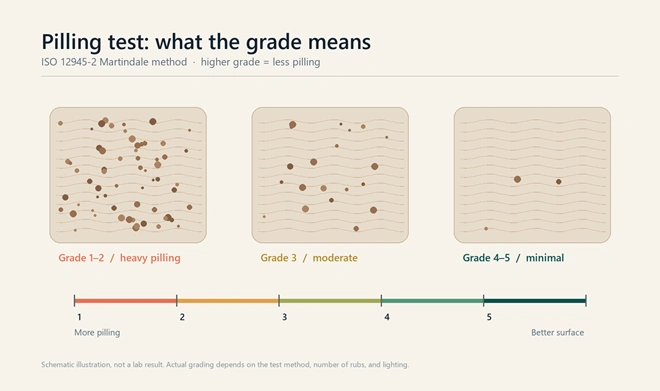
Fabric Pilling is the small balls of tangled fiber that appear on the surface of a fabric after rubbing. It happens when loose fibers work their way out of the yarn, tangle, and form a pill. The inner thigh, the seat, and the waistband are common sites because they rub against the body or other surfaces. Fiber type matters: weaker fibers break and pill more easily, and some staple blends pill faster than filament yarns. Yarn twist, knit density, and surface finishing also change the result. A very soft hand feel can come with a loose surface that pills quickly.
You can do a simple home check by rubbing the inner thigh area against itself or against a rough cloth for a minute, then looking for fuzz or small balls. That is only a signal, not a grade. Brands test pilling under controlled abrasion, often using the Martindale method in ISO 12945-2, and grade the surface on a scale where a higher number is better. For a practical breakdown of the method and the grade scale, see fabric pilling test standards. If a brand claims a specific grade, ask which method was used, how many rubs were applied, and whether the result came from an independent lab or an internal test.
3. Stretch and recovery: two different numbers
Stretch and recovery are not the same thing. Stretch percentage tells you how far the fabric extends. Recovery tells you how well it returns to its original length. A legging can stretch 80 percent and still bag out if the recovery is poor. Pull the knee and the waistband, hold for about ten seconds, release, and watch whether the fabric snaps back or stays loose. If the fabric is sold as four-way stretch, check both directions; a fabric that stretches across but not lengthwise may still feel restrictive.
The number that best predicts bagging is residual deformation after repeated extension. Depending on the fabric, brands may test with ASTM D2594 for low-power knits or ASTM D4964 for elastic fabrics. Ask for the test direction, the number of cycles, and the recovery after washing. A single “stretch” figure without those details does not tell you how the leggings will behave after a month.
4. Seams and waistband: where good fabric still fails
Run a finger along the inner thigh seam. A flatlock seam or a well-executed overlock should lie flat without a bulky ridge. Look for skipped stitches, loose thread, and puckering. A seam that is tight and stiff can create a ridge under stretch; a seam that is too loose can grin. Check the crotch area as well, especially if there is a gusset. A gusset can improve comfort, but it does not fix poor fabric recovery.
For the waistband, check whether it stays up without folding over, whether the elastic is covered, and whether the center-back seam lies flat. A wide waistband is not automatically better; construction and elastic recovery matter more than width. If the waistband twists or digs in after a few minutes, the leggings are likely to be uncomfortable during movement.
5. Washing and care: the test after the test
Read the care label before you buy. Hot water, tumble drying, fabric softener, and chlorine can accelerate fiber damage, shrinkage, and loss of recovery. Before you commit to a pair, wash one pair according to the label and compare the measurements. Measure the waist, inseam, and knee width before and after one wash, and dry it the way you normally would. If the leggings shrink beyond the label’s tolerance or lose their shape, return them. Also check for color bleeding and cracked prints.
For dark colors, wash inside out in cold water. Avoid fabric softener on spandex; it may reduce stretch recovery over time. Line dry when possible, and keep swimwear or activewear away from chlorine unless the label says otherwise. These habits will not rescue a bad fabric, but they will slow the decline of a good one.
The five-check summary
A pair that passes all five checks is not guaranteed to last forever, but it is far more likely to keep its shape, opacity, and surface than a pair that fails two or three. Start with the squat test, then pilling, stretch recovery, seams, and washing. If you are choosing between two pairs with similar labels, the one that passes the checks is usually the better buy.
Wenruo is a fabric development engineer at Forall Lab, working with nylon-spandex knits for activewear, swimwear, and seamless programs. She writes about fabric specification, testing, and mill-floor problem solving, translating lab data into decisions that product teams and shoppers can act on.