
Fashion bags protect purchases while carrying your brand far beyond the checkout counter. However, sourcing them has become much more complex than simply choosing a material labeled “eco-friendly.” The real challenge is finding the right balance of reuse, verified supply chains, brand presentation, durability, and landed cost. This article is about the Top 5 Sustainable Bag Materials for Fashion Retailers in 2026.
The industry’s understanding of sustainability has matured. In 2026, the Textile Exchange shifted its framework from simply ranking “preferred materials” to focusing on “preferred production systems”. They recognize that how a fiber is produced matters just as much as what the fiber is called.
With global fiber production reaching an all-time high of roughly 132 million tonnes in 2024 and recycled fibers accounting for only about 7.6% of that supply, traceability is no longer just a marketing buzzword. It is a practical procurement necessity.
Rather than treating sustainability as a simple ranking system, fashion buyers must evaluate materials based on their specific retail use case. Here is a breakdown of five sustainable bag materials and how they fit into modern retail operations.
Key takeaways:
- These five materials suit different sourcing use cases, not a sustainability ranking.
- A material name alone does not verify environmental performance or certified content.
- Buyers should consider reuse, load, certification, MOQ, printing, freight, and landed cost together.
Which Sustainable Bag Material Is Best for Fashion Retailers?
There is no universally best option.
rPET suits durable reusable programs with recycled-content requirements. Cotton canvas fits premium branded totes. Woven polypropylene (PP) works for heavier loads and frequent use. Jute offers a natural texture, while FSC-certified or recycled paper suits lightweight checkout packaging.
Each material is evaluated, rather than scored, against:
- reuse and load capacity;
- branding requirements;
- material verification;
- MOQ and freight;
- market requirements;
- total landed cost.
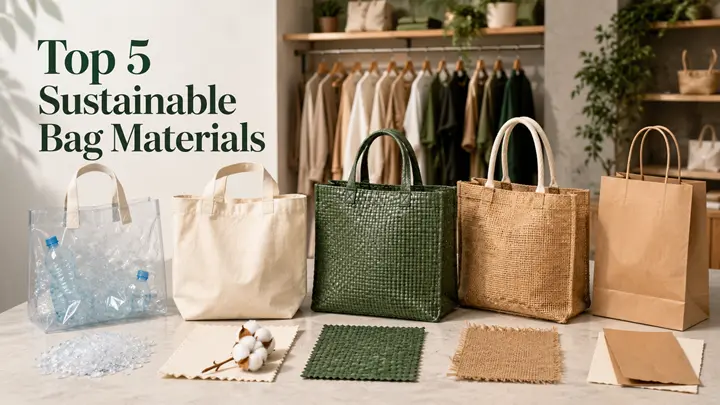
5 Sustainable Bag Material Options for Different Fashion Retail Use Cases
1. rPET (Recycled Polyurethane Terephthalate)
rPET is polyester made from recycled PET feedstock. It offers a strong recycled-content option while retaining the durability and practical characteristics of traditional polyester.
However, the name “rPET” alone does not prove the material is actually recycled. Polyester represented 59% of global fiber production in 2024, and a staggering 88% of that was still fossil-based. Because the supply of recycled polyester is still relatively small, buyers must demand evidence.
Do not rely on a supplier’s company-level credentials alone. For example, if you are vetting a reusable shopping bags supplier like BK Bags, you’ll see they carry credentials like GRS (Global Recycled Standard), FSC, and BSCI. While BSCI proves social compliance, you still need to request the specific GRS transaction documentation for your exact rPET SKU to prove the material’s chain of custody.
Where this makes the biggest impact: Fashion chains, sportswear retailers, and brands with strict, formal recycled-material sourcing mandates.
2. Cotton Canvas
Cotton canvas suits fashion retailers who want their packaging to double as a visible, long-lasting tote bag long after the initial purchase. It offers a premium textile feel, a broad print area, and total flexibility in construction.
But “cotton” is not an automatic sustainability claim. According to the Textile Exchange’s 2025 Materials Market Report, only about 34% of global cotton production came from certified sources. Life-cycle assessments show that the environmental footprint of cotton varies wildly based on geography, farming practices, and energy use. When sourcing canvas, you must look past the fiber name and verify the specific production system, shrinkage rates, and dyeing processes.
The ideal use case: Premium apparel brands, boutiques, and lifestyle retailers seeking strong brand presentation and continued daily reuse by the customer.
3. Woven Polypropylene
Woven PP prioritizes sheer strength and load capacity over a natural-fiber aesthetic. However, its sustainability case requires context. PP is still a plastic, meaning the term “reusable” shouldn’t be accepted as an automatic environmental victory.
Life-cycle assessments (LCAs), such as the benchmark study by the UK Environment Agency, show that the environmental justification for heavier plastic bags relies heavily on the consumer actually reusing them. If you are sourcing woven PP, your primary focus should be on material GSM (grams per square meter), handle reinforcement, and lamination quality to ensure the bag actually survives years of heavy shopping use.
This approach makes the most sense for: Footwear brands, outlet stores, department stores, and high-volume retailers that require bags capable of handling heavy or repeated loads.
Explore: What is Non-woven Fabric? Types of Non-woven Fabric
4. Jute
Jute is an incredibly important renewable natural fiber that offers a coarse, distinctive texture. It is a staple for craft-led fashion branding, but buyers must remember that “renewable” does not automatically mean “low impact.”
The sustainability of a jute bag can be compromised during the manufacturing process. You need to carefully evaluate the dyeing process, the handle materials, and whether the bag uses plastic lamination. Plastic linings or composite components can severely limit the bag’s end-of-life recycling options, so these choices should be tightly controlled during the specification phase.
Who should focus on this: Boutique fashion, resort retail, gift programs, and brands where a natural, tactile aesthetic is a core part of the packaging design.
5. FSC-Certified or Recycled Paper
Paper serves a fundamentally different role than long-life textile totes. It is ideal for retailers prioritizing clean presentation and lightweight checkout packaging.
The primary sourcing question here is not simply “paper or plastic,” but what specific fiber claim applies to the finished product. To ensure sustainability, buyers must look for FSC Chain of Custody certification, which tracks eligible forest-based materials through the supply chain. You must also evaluate how coatings, adhesives, and wet-strength finishes might impact the bag’s compatibility with local curbside recycling systems.
This material is non-negotiable for: Apparel boutiques, footwear stores, and fashion-beauty retailers that need lightweight, highly recyclable checkout packaging rather than a long-life tote.
Sustainable Bag Materials Compared
| Material | Best for | Main strength | Main sourcing check |
| rPET | Recycled-content reusable bags | Durable with recycled-input potential | Verify recycled content and chain of custody |
| Cotton canvas | Premium branded totes | Textile look and reuse potential | Fiber source, production system, fabric spec |
| Woven PP | Heavy or repeated shopping use | Strength and load capacity | Construction, material quantity, intended reuse |
| Jute | Boutique and natural branding | Distinctive texture | Weave, finishes, printing, composite materials |
| FSC/recycled paper | Lightweight retail packaging | Fiber-based presentation | Fiber claim, coatings, recyclability, FSC status |
This is not a sustainability ranking. Each material serves a different retail need, and outcomes depend on production system, specification, use, transport, and end-of-life.
What Should Fashion Retailers Ask Before Ordering Sustainable Shopping Bags?
Finding the right material is only the first step. Before committing to a purchase order, retail buyers must lock down:
- Sourcing Verification: Confirm whether the certification (like GRS or RCS) applies to the entire company, the facility, or your specific product.
- MOQ and Customization: Check if different sizes, colors, or artwork changes carry separate Minimum Order Quantities.
- Quality Control: Certification verifies claims within its scope; it does not guarantee your bag’s handles won’t snap. Always approve physical samples for seam strength and load performance.
- Total Landed Cost: Compare the final cost, including customization, packing efficiency, sea freight, duties, and receiving costs, rather than just the headline unit price.
The most appropriate sustainable bag isn’t determined by its material name alone. By comparing verified production systems, intended customer reuse, and total landed costs, fashion retailers can select the packaging format that best supports both their commercial goals and their sustainability targets.
FAQ: Sustainable Bag Sourcing
Is rPET more sustainable than cotton canvas?
Not universally. rPET supports verified recycled content, while cotton canvas can suit longer reuse and premium presentation.
Does “recycled” on a bag mean it is certified?
No. Buyers should request GRS or RCS documentation to verify recycled-content claims.
What does FSC certification confirm for paper bags?
It verifies eligible forest-based materials through the supply chain. Buyers should confirm the specific bag carries the appropriate FSC claim or label.