
Types of Textile Finishing Processes in the Textile Manufacturing Industry
The finishing process in textiles is the final stage. We basically describe it for the finalization of materials. There are different stages in the finishing of textiles. Such an example is that yarn or thread is the final product of the textile yarn manufacturing process. And like that, knit fabric or woven fabric is the final product of fabric manufacturing. So while finalizing the product, we use some special steps to make sure it is okay and ready for the next operation. So finishing is an important part of textile manufacturing. In this article, we discuss the Types of Textile Finishing Processes in the Textile Manufacturing Industry.
Have you ever slept upon crisp cotton sheets or worked in the fire while wearing a flame-proof jacket? Then you enjoyed the blessing of finishing. Most of the fabrics are produced in the factory. But after the production, it is not able to wear as it is. So, some treatments should be carried out. Different types of finishing processes are carried out in the textile industry to improve the properties, appearance, or handle of the final fabrics.
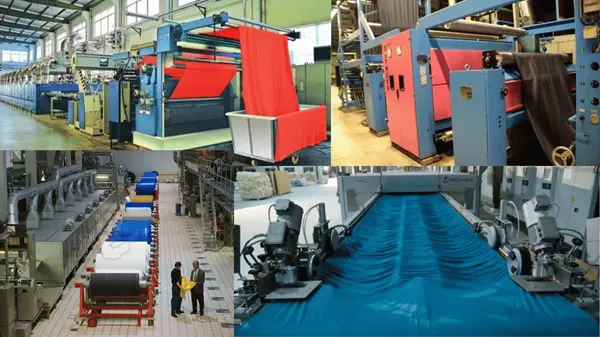
Objectives of Textile Finishing in the Textile Industry
- Improve the attractiveness and repairability of textile material.
- It accedes or inhabits some natural characteristics on textile materials (such as softening, stiffening, de-luster, etc)
- Finishes impact new characteristics/properties to the textile materials (such as permanent press, flame retardant)
- It increases the life and sturdiness of the textile material.
- It sets the material, so it maintains its form and structure.
Types of textile finishing: On the basis of purpose
- Aesthetic finish: It modifies the appearance of the hand or drape of the fabrics. For example:
- Handle
- Softness
- Lustre
- Fulling (volume increase of fabric)
- Compaction of wool
- Mercerization
- Napping
- Sueding
- Plisse
- Shearing
- Stiffing
- Softening
- Functional finish:
- Performance-related finishing.
- Functional properties of fabric can be changed by using chemical or physico-chemical techniques.
- To improve multiple functional properties, polymers are chosen instead of simple chemicals.
- A few finishes are listed below that improve the functional properties of fabric:
| Finish | Suitable fabric |
| Wrinkle resistance | Cellulosic fibers and their blends |
| Flame retardency | Most of the natural fiber and some synthetic fiber |
| Absorbency | Provides hydrophilicity to synthetic fibers |
| Soil release | Synthetic fibers and their blends |
| Water repellency | Cellulosic fibers |
| Resistance to micro-organism | All fibers for medical purpose |
| Resistance to insect | Mostly for wool |
| Resistance to static charge | Synthetic fibers |
| Resistance to pilling | High tenacity synthetic fibers and their blends |
| Abrasion and wear resistance | Cellulosic fibers and their blends |
| Thermal conductivity | All natural & synthetic fibers |
| Resistance to heat, UV light and pollutant | Natural and synthetic fibers |
Types of textile finishing: On the basis of durability
- Temporary finish:
- This finish remains up to one wash. This finishing washes away with washing. Life expectancy is very limited. Calendering, embossing, softening, and starching are examples of temporary finishes.
- Paste containing starch and gum, filling agent, softening agent, glazing agent, wetting agent, and optical brightener are used for a temporary finish.
- Ingredients amount depends on the quality and hand feel that we want from the fabric.
- Softener imparts softening and glazing to the fabric surface. Wax emulsion, polyethylene emulsion, and glaring paste can be used.
- Starches like tapioca or maize can be used to impart stiffness and body lustre.
- For further finishing, wetting agents are used to wet the fabric quickly.
- To compensate slight yellow tinge of the finished fabric, optical brightener like Victoria blue or acid violet can be used.
- French chalk, china clay act as filling agents and fill the fabric.
Temporary finish: Temporary finish is of 3 types. Here they are:
- Pure finish: The cloth is stretched to a definite width, lightly calendered without adding any substances to improve appearance.
- Medium finish: Pure & medium finishes are given to fine fabric by increasing the weight of the fabric from 5% to 7% by using starch.
- Heavy finish: Heavy calendering is given to poor-quality fabric to convert the original unpleasant feel of the fabric into a smooth feel.
2. Semi-permanent finish
- Durable up to 5 to 10 washes.
- Durability lies between temporary and permanent finishes.
- Its average lifespan depends on the finish used on the fabric.
- Schreiner calendering or buckram finish are examples of a semi-permanent finish.
· Schreiner calendering: This operation gives a silk-like brilliance to cotton fabric. This is carried out on cotton linings, sateen, and printed fabric. Schreiner steel bowl contains 250 to 350 lines per inch to provide a soft, lustrous handle to the fabric. A 200-degree angle engraved line with 500 lines per inch givesa very lustrous effect. This finish lasts up to 5 to 10 washes.
Schreiner Calendering..is it a little bit confusing? Let’s find all about it…..
3. Permanent finish:
- Remains unaffected under all the conditions of wear and treatment.
- Lasts usually upto 20 to 30 wash.
- Done by chemical treatment.
- Some examples are listed below:
- Resin finish
- Sanforising (give dimensional stability by decreasing distance between warps and wefts)
- Flame proof
- Water proof
- Moth proof
Types of Textile Finishing Processes in the Textile Manufacturing Industry
There are two forms of finishing textile materials.
- Mechanical Finishing
- Chemical Finishing
1. Mechanical Finish
Mechanical finishing is used for dimensional stability and measurement issues. We also do mechanical finishing for out looking of textile material. Such mechanical finishes are as follows. Calendaring, Off guard and sueding, Sanforizing, Brushing, and Shearing are the most used mechanical finishing.
- These are given by mechanical arrangements.
- Drying cylinders or a stenter machine function can be used to provide a series of calendering processes.
- Mechanical finish is usually temporary.
- But a few permanent finishes can also be achieved.
- It is known as a dry finish.
- Some examples are given below:
| Temporary mechanical finish | Permanent mechanical finish |
| Beetling | Raising |
| Calendering | Crepe effect |
| Embossing & glazing | Parchmentizing |
| Breaking | Napping & brushing |
| Stretching | Sanforizing |
| Tentering | Shearing |
| Glazing | Decating |
| Decating | Tentering |
| Moireing | Singeing |
2. Chemical Finish
Chemical finishing is used for protecting textiles. This is the final stage process for the end product using textile materials. We use it to create shiny protection and to enhance performance or serviceability. There are different types of chemical finishes in the world. Hymenopter creasing, Softening, Stiffing, Soil unharness, Anti-static, Rot-proofing, Anti-bacterial, organic compound finishes, etc., are the most used textile finishes.
- Chemical methods involve the application or deposition of chemicals or the carrying out of a chemical reaction on the fabric.
- Generally, chemical finishes are permanent.
- But only a few may be temporary, such as an Anionic softener finish.
- Chemical finishes should be given uniformly throughout the fabric in order to change the chemical properties of the fabric.
- In this process, a chemical solution is applied with a suitable applicator. Then, excess water is removed by drying, and heating is carried out to activate the chemical.
- Proper formulation ofa chemical finish is quite difficult. Some factors are considered before finalizing the formulation. They are listed below:
- Composition and construction of textile
- Performance required
- Ø Required procedure
- Ø Environmental aspect
- Ø Availability of machinery
- Ø Compatibility with other chemicals
- For economical reason different types of chemical finishes are combined in one bath but it is the most challenging part. Because all the chemicals should be compatible with each other.
- Some components assists each other like silicone elastomers may enhance water repellency, softeners may bring additional antistatic effects and antistatic finishes can soften material further.
- On the other hand, some agents may impart opposite effects; for example, hydrophobic finishes and hydrophilic antistatic finishes, or stiffening and elastomeric finishes, or stiffening and softening finishes.
- While choosing Chemical finishes check the following criteria:
- Cost effectiveness
- Stability during storage and application
- Compatibility with other chemicals
- Bio-degradability
- No release of volatile compound
- Eco-friendliness and non-toxicity
- No staining or yellowing of white stuffs
- Stability during washing and dry cleaning
- A list of permanent chemical finish are given below:
- Mercerizing
- Parchmentizing
- Silicon treatment for hydrophobic effect
- Fluoro chemicals for soil release & soil resistance
- Certain phosphorous & nitrogen compounds for flame retardant
- Wrinkle free or crease resistant finish
- Anti-microbial finish
- Anti-static finish
Conclusion
The Finishing processes in the Textile industry are the final processes, but carry very high importance. It improves appearances like enhanced luster, color, and texture; Enhanced performance like Water repellency, flame resistance, and wrinkle resistance; and Increased comfort like Softness, breathability, and moisture management.