
Screen Printing
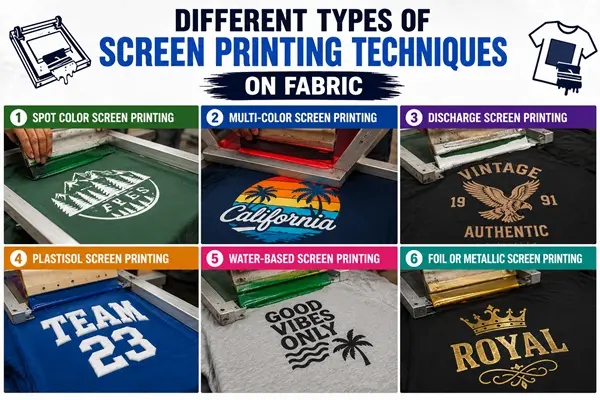
Screen printing is a manufacturing process to transfer text, images, or text images onto a t-shirt or other piece of clothing. It required a stencil to create a fine mesh screen. By using a squeegee, the ink is applied to the fabric. At first, the ink will go through the openings of the stencil and make the desired design on the fabric. Screen printing is vastly popular for creating custom design t-shirts and other garments. It can do brighter prints even on darker materials. Here, I present Different Types of Screen Printing Techniques on Fabric.
Screen printing, also known as silk screening or serigraphy, is a versatile printing technique used to transfer ink onto various materials such as fabric, paper, metal, plastic, and glass. There are different types of screen printing methods based on the specific requirements and desired outcomes.
In case of manual screen printing in the textile industry, the fabric lies on a long table on top of the printing blanket. This blanket is typically a cotton or polyester cloth, water-proofed by a coating of neoprene rubber. If the fabric slips or deforms during printing, there is a loss of print definition. The fabric is therefore usually pinned to the printing blanket, or stuck into it with a water-based gum or thermoplastic adhesive. The latter type coats the blanket surface but only becomes sticky when heat softens the polymer.
In semi-automated screen printing, a mechanically driven squeegee transfers the color. This often has a pair of parallel rubber blades, with the printing paste held between them. When passing across the screen printing, only the trailing blade is in contact with the screen surface. The leading blade drops and the trailing blade rises, ready for the back stroke at the end of the stroke. At the end of each stroke, this removes the need to lift the squeegee over the residual paste.
During printing, the Zimmer rolling rod applicator moves through the printing screen along the fabric length which is driven by an electromagnet below the blanket. The roller is too small that paste can flow over it so that lifting is not needed. This type of roller gives less screen wear.
Working Principle of Screen Printing
The technique of screen printing involves pressing ink through a fine mesh screen onto a substrate. The mesh fabric is laid over the fabric, then a stencil is applied to it. Then the ink is pressed onto the fabric through the mesh screen. The whole process is done by the squeegee to force the ink through the mesh.
Advantages of Screen Printing in Textile:
Screen printing has some advantages, which are pointed out in the following:
- It needs relatively cheap equipment.
- It has very few preliminaries.
- This type of printing permits printing on almost any surface.
- Areas of far greater size can be stenciled. Frames 1.27m X 1.52m (50” X 60”) are frequently used for textile printing.
- It is very economical for short runs of suitable subjects and so widely used for posters, show cards etc.
- The surface to be printed need not be flat.
Different Types of Screen Printing
These are the Different types of Screen Printing on fabric:
1. Flatbed Screen Printing
This is the traditional method of screen printing, where a frame with a mesh screen is placed flat on the substrate. Ink is pushed through the screen using a squeegee, and the desired image or design is transferred onto the material. In the case of flatbed screen printing, the screen consists of a woven polyester material, tightly stretched across the underside of a light, rectangular frame. In the printing period, the screen usually lies across the fabric width. The polyester fabric only allows the printing paste to pass through the mesh in those areas corresponding to the design being printed. A suitable coating blocks the remaining areas. There is a screen for printing each color, and each consecutive screen sits on the fabric in the exact place for accurate registration of the multi-color design.
2. Rotary Screen Printing
In this method, the screen is cylindrical and rotates continuously. The substrate moves beneath the rotating screen, and ink is forced through the mesh onto the material. Rotary screen printing is often used for high-volume production and is capable of printing at high speeds.
3. Overprinting
Overprinting involves printing multiple layers of ink on top of each other to create complex designs, shading, or color mixing. Each layer of ink is dried or cured before applying the next layer. This technique allows for the creation of vibrant and detailed prints.
4. Spot Color Printing
Spot color printing involves using premixed inks to achieve specific colors. Each color in the design is separated into individual screens, and ink is applied through these screens one color at a time. Spot color printing is commonly used for logos, text, and designs that require precise color matching.
5. Four-Color Process Printing
Also known as CMYK printing, four-color process printing is used to reproduce full-color images or photographs. It uses four primary ink colors—cyan, magenta, yellow, and black (CMYK)—to create a wide range of colors through color mixing and halftone patterns. Each color is printed using a separate screen, and the overlapping dots create the illusion of continuous tones and shades.
6. Discharge Printing
Discharge printing involves using special inks that remove or discharge the existing dye from a colored fabric. The ink contains a discharge agent that reacts with the fabric dye, effectively bleaching out the color. This method is often used on dark-colored garments to achieve soft and vintage-looking prints.
7. Heat Transfers
Heat transfers involve printing the design onto a special transfer paper and then using heat and pressure to transfer the ink from the paper onto the material. This method is commonly used for printing on fabrics, such as the t-shirt printing method, and allows for detailed and full-color prints.
Outlines of Screen Printing
- Design Creation: The first step in screen printing is creating the design. This is often done with a computer graphics design program, such as Adobe Illustrator. The artwork is then printed onto a transparency film.
- Screen Preparation: In this method, we prepare the screen for printing. This involves stretching a mesh screen over a wooden frame, coating the mesh with a photosensitive emulsion, and burning the artwork into the emulsion with a light source.
- Printing: Once the screen has been prepared, it is ready for printing. Ink is rolled onto the screen and then pushed through the mesh with a squeegee. The ink is then transferred onto the substrate, such as a t-shirt. It offers stylish fished products.
- Clean Up: Once the printing is complete, the screen must be cleaned and the excess ink must be removed from the screen and substrate.
- Drying: The final step is to dry the substrate and let the ink cure. This is usually done with a heat press or other drying device.
Screen Printing Using Place
Screen printing is used for a lot of purposes that include printing on textiles, promotional materials, and labels. It is commonly used to print designs on t-shirts, sweatshirts, tote bags, mugs, and other items. Screen printing can be used to produce artwork, logos, and text on a wide range of objects.
Where can we use Screen Printing?
- 1. T-shirt
- 2. Mugs
- 3. Bags
- 4. Sweatshirts
- 5. Hats
- 6. Posters
- 7. Boxes
- 8. Flyers
- 9. Medical Devices
- 10. Key chains
There are many more places where we are using screen printing. It is easy to print, and many entrepreneurs are working and making money by doing screen printing.
Why is screen printing great?
Because of its versatility, screen printing is better than other techniques. It is vastly popular for t-shirt printing. By using this screen printing you can easily make the image, and text printed on the t-shirt. Screen printing is relatively easy to learn and most cost-effective. That makes the screen printing great.
- 1. Cost-effective: To do anything what first comes to our mind? Money. Whatever we want to do at first we think about the cost. Compared to other printing methods screen printing is more cost-effective. This is because once you set up the stencil you can use it repeatedly on as many similar products as you want.
- 2. Fast: By using screen printing, we can print very fast. If we compare the printing time of other printing processes to screen printing it’s almost 0.5% minimum faster than other processes.
- 3. Versatile: Another important advantage of screen printing is its versatility. Like one stencil you can print multiple types of printing.
- 4. Efficient: The process of screen printing is very easy. There are not many complicated processes involved. That’s why it’s more efficient.
- 5. High-quality print: Cost-effectively it produces better printing quality than other printing processes.
Now a day’s new printing processes or methods are coming. But nothing is more easy and more cost effective than screen printing. Although screen printing is one of the oldest methods of printing still remains one of the most reliable printing methods. That’s all on types of Screen Printing, and Its Use.
Conclusion
- Related Post: Screen Printing vs Digital Printing: Difference Between Screen and Digital Printing
- Differences Between Direct-to-Garment (DTG), Direct-to-Film (DTF), & UV Printing
- Different Apparel Printing Tech: DTF vs. Screen Printing vs. Sublimation
- Heat Transfer Printing vs Screen Printing
- 10 Best Screen Printing Accessories Review and Buying Guide