
How to Calculate Knitting Cost per kg in the Textile Industry?
Knit Fabric Cost and Knitting Cost Calculation per kg:
Knitting cost calculation is too important to achieve greater output in the textile business. Coz it is very competitive in the textile market. It is not an easy task that we normally do. This article will help you to learn the exact calculating method for knit fabric cost and knitting rate calculation. Here we are discussing how to Calculate Knitting Cost per kg in the Textile Industry.
Knit is cheaper than woven, so businessmen choose to go for the knitting business over woven. Here, every single penny matters. So it is a very important thing to know how to calculate knitting costs.
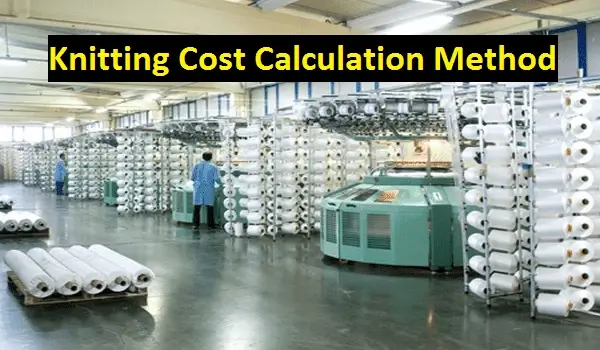
Knitting Cost Calculation Method in the Textile Sector:
Find out the knitting cost & rate and knitted fabric cost & price from the chart below.
| Parameters | Amount or Quantity |
| Total machine | 2 |
| Shift per day | 3 |
| Production capacity per shift | 70kg per machine |
| Yarn used | 1000kgs |
| Yarn price | Rs. 200 per kg |
| Knitting wastage | 2% |
| Operator wages | Rs. 200 per shift |
| Helper wages (In production) | Rs. 100 per shift |
| Inspection wages | Rs. 200 per shift |
| 1 helper | 2 machines |
| 1 operator | 1 machine |
| Inspection worker | 1 person |
| Power | Rs. 4000 per month |
| Rent | Rs. 8000 per month |
| Transport | Rs. 6000 per month |
| Salary | Rs. 25000 per month |
| Other expenses | Rs. 24000 per month |
| Profit | 10% |
Solution:
To calculate the knitting cost and rate, we have to follow the formulas below for knitting cost calculation per kg basis:
1. Fabric Manufacturing and Selling Cost Calculation:
Knit fabric cost/kg,
Direct material (D.M) + Direct labor (D.L) + Direct expenses (D.E) + Overhead (OH)
= …………………………………..………………………………………..…………………….… ….(1)
Total production
2. Knit Fabric Manufacturing Cost calculation:
Knitting cost/kg,
Direct labor (D.L) + Direct expenses (D.E) + Overhead (OH)
= …………………………………………………………………………… ………….. (2)
Total production
Total Production Calculation:
Total production,
= Yarn used –wastage%
= 1000-2%
= 1000-20
= 980kg
Total Production Time Calculation:
Total production time = Total production/production capacity per shift …………………… (3)
Now,
Production capacity/shift,
= No. of machines × capacity
= 2×70
= 140kg
Now, from equation (3), we get,
Total production time,
= 980/140
= 7 shift
Direct Material (D.M) Cost calculation:
Yarn cost,
= 1000 × Rs. 200
= Rs. 200000
Direct Labor (D.L) Cost calculation:
Operator wage = No. of operator × No. of shifts × Rs. 200 = 2×7×200 = Rs. 2800
Helper wage = No. of helper × No. of shifts × Rs. 100 = 1×7×100 = Rs. 700
Inspection wage = No. of inspector × No. of shifts × Rs. 100 = 1×7×200 = Rs. 1400
So,
Direct labor (D.B) cost,
= Rs. 2800+ Rs. 700+ Rs. 1400
= Rs. 4900
Direct Expense (D.E) Cost Calculation:
Direct expense = 0
Overhead (OH) Cost Calculation:
In the case of power,
= (Cost × 7 shifts)/ (30days× 3 shifts in a day) = {(4000×7)/90} = Rs. 311
In the case of rent,
= (Cost × 7 shifts)/ (30days× 3 shifts in a day) = {(8000×7)/90} = Rs. 622
In the case of transport,
= (Cost × 7 shifts)/ (30days× 3 shifts in a day) = {(6000×7)/90} = Rs. 467
In the case of salary,
= (Cost × 7 shifts)/ (30days× 3 shifts in a day) = {(25000×7)/90} = Rs. 1944
In case of others expense,
= (Cost × 7 shifts)/ (30days× 3 shifts in a day) = {(24000×7)/90} = Rs. 1867
So,
Total overheads,
= Rs. 311+ Rs. 622+ Rs. 467+ Rs. 1944+ Rs. 1867
= Rs. 5211
Now, from equation (1), we get,
Knit fabric cost/kg,
= {(200000+4900+0+5211/980)} = Rs. 214.40
After adding 10% profit, knit fabric cost stands at,
= {214.40/ (1-10%)}
= Rs. 238.20
Again,
From equation (2), we get,
Knitting rate or knitting cost per kg,
= {(4900+0+5211)/980}
= Rs. 10.30
After adding 10% profit, the knitting rate stands at
= {10.30/ (1-10%)}
= Rs. 11.45
- You may love to read: Types of Cost or Costing in Textile and Apparel Business