
Merino wool is often marketed as if fiber identity alone guarantees a high-performance sock. In practice, a sock is a compact engineered textile system. Fiber diameter, blend ratio, yarn structure, plating, stitch density, cushioning, reinforcement, fit, and finishing all contribute to the wearer’s experience. A technically credible product assessment therefore begins with composition but does not end there. Merino Wool Sock Performance: From Fiber Selection to Knit Engineering.
This article reviews the main variables that turn merino fiber into a durable, comfortable sock and identifies the questions developers, buyers, and quality teams should ask.
1. Fiber Properties and Wearer Comfort
Wool is a hygroscopic protein fiber. Its internal structure can absorb moisture vapor, while the fiber surface is comparatively hydrophobic. In a sock, this behavior can help buffer the humid microclimate next to the foot. Sorption and desorption also involve heat exchange, which contributes to wool’s reputation for thermal comfort across changing conditions.
Merino generally refers to fine wool sourced from Merino sheep. Fiber diameter strongly influences perceived softness: finer fibers bend under lower force and are less likely to trigger the prickling sensation associated with coarse wool. However, “merino” is not a complete specification. Staple length, strength, crimp, color, contamination, and processing history also affect spinnability and final quality.
Wool’s odor performance is relevant but should be described carefully. By managing moisture and binding some odor compounds, wool can delay noticeable odor under certain wear conditions. It is not sterile, and performance varies with the wearer, shoe, environment, finishing treatments, and care.
2. Why Sock Yarns Are Frequently Blended
Pure wool maximizes natural-fiber content but may not provide the abrasion resistance, recovery, and manufacturing consistency required at every zone of a modern sock. Common supporting fibers include:
- Polyamide/nylon: improves strength and abrasion resistance, especially at the heel and toe.
- Elastane: supplies stretch and recovery at the cuff, leg, instep, and arch.
- Specialty functional yarns: may target odor, moisture, conductivity, or durability, but require claim-specific substantiation.
The stated overall composition does not reveal how fibers are distributed. A wool-rich body can coexist with nylon-plated high-wear zones and elastane incorporated into selected courses. For developers and buyers, a fiber map is more informative than a single percentage.
3. Yarn and Knit Architecture
Yarn count, twist, ply, hairiness, and evenness affect both processing and hand. Higher twist can improve cohesion and resistance to abrasion but may produce a firmer feel. Plied yarns can improve balance and uniformity. The knitting machine gauge must suit the yarn diameter and intended density; forcing an incompatible combination can lead to poor cover, high needle stress, or an overly rigid fabric.
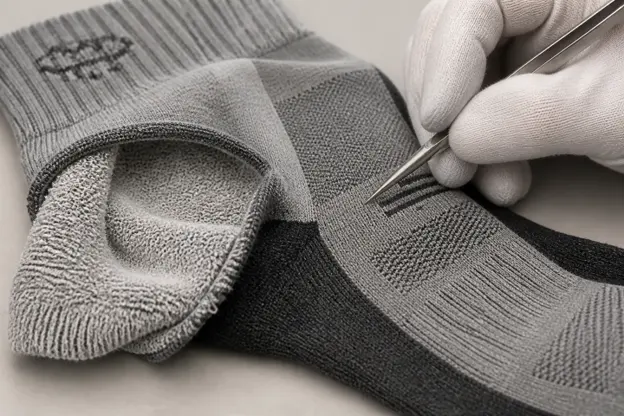
The sock’s zones then translate material properties into function:
- Rib structures at the cuff provide extensibility and recovery.
- Mesh or tuck structures over the instep can increase air permeability.
- Elastic courses around the arch can improve hold, provided pressure remains comfortable.
- Terry loops at the sole add cushioning and thermal insulation but increase bulk.
- Reinforced heel and toe areas address concentrated abrasion.
- A well-shaped heel pocket and toe closure support fit and reduce excess fabric.
Image alt text: Macro quality inspection of merino sock cushioning, mesh knit, and reinforced wear zones
4. Easy-Care Finishing and Its Trade-Offs
Untreated wool scales can interlock under heat, moisture, and mechanical action, causing felting shrinkage. Machine-washable wool therefore depends on fiber treatment, polymer application, plasma-based modification, garment construction, or a combination of methods. Each route has performance, environmental, cost, and hand-feel implications.
A supplier should specify the treatment and the verified care protocol. “Machine washable” must be paired with a maximum temperature, cycle, detergent guidance, drying method, and dimensional-stability criteria. Commercial claims should be supported by test reports on the finished product, not only by certification for an upstream yarn.
5. A Real-World Product Architecture
Examining a commercial range helps illustrate how specifications change with use. MP Magic’s merino wool socks are offered in multiple constructions rather than one universal style. According to the current product information, the classic basic crew uses an 82% merino wool, 13.5% nylon-based special yarn, and 4.5% Lycra blend; the lightweight crew uses 74% merino wool, 25% nylon-based special yarn, and 1% Lycra; and the sport crew lists 53% merino wool, 30% nylon-based special yarn, and 17% Lycra.
These published specifications show a recognizable design logic: a higher wool share for a classic thermal-comfort product, reduced bulk in a lightweight daily style, and more stretch/support material in a sport-oriented construction. The percentages alone do not prove comparative performance, but they are a useful starting point for evaluating whether architecture matches end use.
6. Quality-Control Priorities
A hosiery control plan should combine material, dimensional, appearance, and wear-relevant checks. Depending on market and claim set, useful assessments include:
- Fiber composition verification using an applicable standard method.
- Sock dimensions in relaxed and extended states, before and after laundering.
- Mass per pair and course/wale density for process consistency.
- Abrasion and bursting behavior at high-stress zones.
- Pilling and surface appearance after wear simulation and laundering.
- Colorfastness to washing, perspiration, rubbing, and light as required.
- Seam quality, toe closure, yarn faults, dropped stitches, and pairing consistency.
- Elastic recovery and top-band pressure appropriate to the target wearer.
- Odor or antimicrobial testing only when a precise claim is being made.
Sampling should reflect color, size, machine, production lot, and finishing batch. Laboratory data are strongest when paired with controlled wear trials, because subjective fit, thermal comfort, slippage, and skin feel are difficult to infer from a single bench test.
7. Responsible Communication
Technical marketing should distinguish inherent fiber tendencies from guaranteed product outcomes. “Helps manage moisture” is more defensible than “keeps feet dry in all conditions.” “Designed with reinforced wear zones” is preferable to an unqualified lifetime durability claim. Antimicrobial, medical, compression, sustainability, and biodegradability language may carry additional testing or regulatory obligations by market.
Conclusion
Merino is a valuable raw material, but successful hosiery depends on how the entire system is designed and controlled. The best products align fiber fineness, blend, yarn, zonal knit structures, fit, finishing, and care with a clearly defined use case. For textile professionals, the essential question is not simply, “How much merino is present?” It is, “Where is each material placed, what function does the construction serve, and how has the finished sock been verified?”