
Fabric spreading means the smooth laying out of the fabric in superimposed layers of specific length & width. The cutting maker paper is laid on top of the fabric layers. The maximum width of the cutting maker is constrained by the usable width of the fabric. In this article, we explain the Fabric Spreading Process in the Apparel industry.
When spreading, the number of pies should not be more than three hundred. The shape of the fabrics attained as per the spreading of the fabric is called the “Fabric Lay”.The number of layers depends on the thickness of the fabric and the height of the knife.
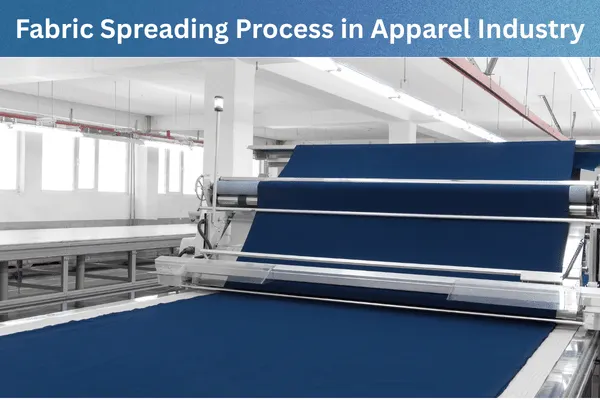
Objectives of Fabric Spreading Process in Apparel:
- To place the number of plies of fabric roll according to the length of the marker plan accurately aligned as to the length & width, without tension.
- To cut garments in bulk & save in fabric, the use of a multi-garment marker plan & the savings in cutting time per garment that result from cutting many pieces at the same time.
- For better control in the cutting process.
Requirements of Fabric Spreading Process in the Apparel Industry
- Alignment of fabric plies ( Basic Requirements)
- Correct ply tension ( Basic Requirements)
- Fabric must be flat ( Basic Requirements)
- Elimination of fabric flaws
- Correct ply direction & lay stability
- Elimination of static electricity
- Easy separation of cut lay into bundles
- Avoidance of the fusion of plies during cutting
- Avoidance distortion in spreading
- Matching checks or stripes
These are the key Requirement Points of the fabric spreading process in the Garments Industry; described every point of Fabric Spreading Process below:
Alignment of fabric plies (Basic Requirements)
Fabric spread is done as per the length. It is exactly maintained so that every one of the material plies is placed flawlessly in the length and width of the marker during the spreading of material. Otherwise, the fabric of any ply that can be placed beyond the measurement of the length or width of the marker may be cut defectively. In order to avoid this mistake, every ply is placed and controlled along the width, maintaining the selvedge of at least one facet within the same line. Also, sometimes along the width of the material, the centre position of it is placed and controlled in an equal place. In order to ensure the period of every ply alongside the marker, the length of material laid is kept 2cm larger than the marker length at both ends.
Correct ply tension (Basic Requirements)
The ply tension should be proper. If the tension is low, there will be ridges in the plies & if the tension is too high, the fabric may shrink after cutting & sewing. Spreading, if completed in a spreading machine, offers uniform tension. Some fabrics, such as knitted fabrics, or within the fabric in which there are elastic yarn or textured yarn, are prone to becoming longer. During the spread of these fabrics, special attention is given, and the fabric is cut 12 to 24 hours after laying, so that the fabric can relax to its normal condition by this time. Fabric Relaxation SOP defines fabric wise relax time.
Fabric must be flat (Basic Requirements)
It should be maintained carefully. The operator must pay attention so that there is no crinkling during fabric spreading. If any crinkling in a flat table, the crinkle is eliminated by airflow.
Elimination of fabric flaws
The flaws of fabric must be indicated during spreading & necessary steps must be taken to remove these faults. It is the duty of the operator. Splicing is one of them. It can be done in two ways: one is by giving an indication in the marker & other is by overlapping the fabric. Sometimes, metal tape is attached to indicate the flaw of the fabric. The computer can easily identify the flaws & the length of the computer & the length of splicing can also be measured by this technique
Correct ply direction & lay stability
These two factors must be considered together. They depend on fabric type, pattern shape & spreading equipment that are available. When the pattern pieces have been positioned in a particular direction in the marker plant, it is essential that the fabric is stretched according to the direction.
Symmetrical pattern pieces are placed in the same way on the face. If the fabrics of patterns are asymmetrical, the fabric is spread either up or down.
Elimination of static electricity
If spreading is done by natural fabrics, static electricity may be generated. It may be eliminated by decreasing the friction or increasing the humidity of the room. The Earthling facility may be provided with the lay to reduce static electricity generation.
Easy separation of cut lay into bundles
During fabric spreading, differentiation marks among the fabric plies may be required due to color or shade variation or any other reason. For making this differentiation, a lower-priced coloured paper layer is used among the material plies. After slicing the material, for differentiation among coloured and non-coloured in every bundle, the usage of such coloured paper may be very an awful lot helpful. Moreover I case of slippery material, such as coloured paper facilitates maintaining the material lying firmly. The coloured paper used for this motive is typically hard-surfaced
Avoidance of the fusion of plies during cutting
During the fabric cutting with the cutting knife, heat is generated due to the friction between the fabric & Knife. The fabrics in which there are thermoplastic fibers, those fibers smelt due to frictional heat. As a result, the melted matter takes the form of a polymer bead or grain due to joining together. To avoid this problem, anti-fusion paper is used. There is a greasy substance in anti-fusion papers that lubricates the knife during the cutting of fabrics
Avoidance distortion in spread
During the removal of fabric lay or during the cutting of the fabric lay with a straight knife, there may be a folding mark or a crinkling mark in the fabric plies at the bottom lay due to the friction with the base plate of the knife. As a result, a defective pattern may be made after the cutting of the fabric. Moreover, due to the use of smooth paper, there is no possibility of a rough fabric surface, caused by the friction of the table with the fabric.
Matching checks or stripes
During the time of making fabric lay through spreading of fabrics, it needs to be kept marked so that if the fabric is taken a look at or stripped, then one ply of cloth needs to be positioned on the opposite side by matching the checks or stripes properly. In the interest of matching the checks or stripes in garments, marker planning also needs to be done by matching the checks and stripes. This matching may be required to be maintained in warp direction, in weft direction, or both in warp and weft directions.
These are all the main requirements of the Fabric Spreading Process in the Apparel Industry.
- Related Post: Fabric Spreading Process in the Garments Industry
- Flow Chart of Garments Fabric Cutting Room
- 10 Requirements of Fabric Spreading in Garments Industry
- Major Problems in Fabric Spreading
- Shade Marking and Inspection in Fabric Spreading
- Factors Considered for Ply Height Determination in Fabric Spreading