
What is Textile Lab Testing Equipment?
The instruments, machines, or equipment are used for different textile testing processes, called Textile Lab Testing Equipment. The Textile Lab Testing Equipment List is very long. When you walk into a textile quality lab, you’ll see rows of machines that look intimidating at first—but once you know what each one does, it starts to make sense. Here’s a working list of the most common fabric lab testing instruments, grouped by the type of test they perform.
What is Fabric Testing?
In the apparel manufacturing industry, garments are made by using different types of fabrics like woven fabric, knit fabric, solid color dyed fabric, etc. Before going to the large-scale production of any garments, the specified fabric must be tested by the manufacturers according to the buyer-suggested standards. In this article, we share the List of Textile Lab Testing Equipment and Fabric Testing Instruments/Machines.
If the fabric quality is not perfect, then the buyer may reject the total order. To avoid such types of hazards, fabrics are tested to identify their actual quality before making the garments, and it is termed fabric testing. Fabric quality parameters are checked in the fabric testing.
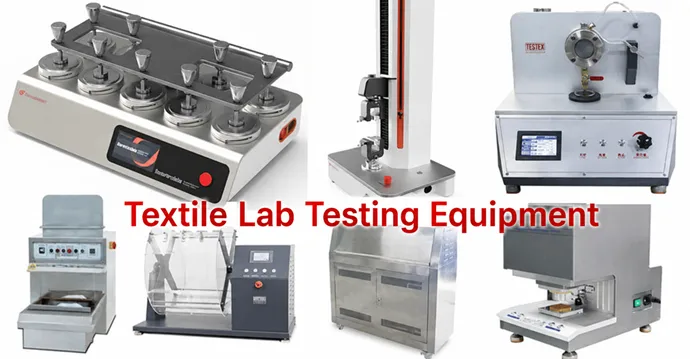
List of Textile Lab Testing Equipment and Fabric Testing Instruments/Machines
A fabric testing machine is used to test the physical characteristics of the fabric, such as fabric fineness, tension strength, density, length, etc. Textile and Fabric lab testing machines include-
- Medical Textiles Tensile Testing,
- UV Accelerated Weathering Tester,
- Martindale Abrasion & Pilling Tester,
- Bursting Strength Tester,
- Fabric Pneumatic Bursting Strength Tester,
- Synthetic Blood Penetration Tester,
- Moisture Management Tester,
- Crumple / Flex Tester,
- Lab High Temp. Steamer
- Universal Wear Tester,
- Air Permeability Tester,
- Auto Air Permeability Tester,
- Wyzenbeek Abrasion Tester,
- ICI Pilling and Snagging Tester,
- ICI Mace Snag Tester,
- Auto Water Vapour Permeability Tester,
- Shrinkage Template Scale,
- 45 Degree Flammability Tester,
- Multi-purpose Textile Flammability Tester,
- Laboratory Tenter,
- Scorch Tester (Sublimation Fastness Tester),
- Washing Fastness Tester,
- Water-cooled Light & Weather Fastness Tester,
- Hydrostatic Head Tester,
- Textile Tensile Testing Machine,
- Fabric Scale,
- Digital Thickness Gauge,
- Downproof Tester,
- Spray Rating Tester,
- Brush or Sponge Pilling Tester,
- Horizontal Flammability Tester,
- Medical Masks Flammability Tester,
- Vertical Flammability Chamber,
- Crockmeter,
- Color Matching Cabinet (Lightbox)
- Horizontal & Vertical Flammability Tester,
- Automatic Shrinkage Washer,
- Light & Weather Fastness Tester,
- Wringer (Lab Padder),
- Scott Type Crease-Flex Abrasion Tester,
- Fryma Fabric Extension Tester,
- Dynamic Seam Fatigue Tester,
- Water Vapour Permeability Tester,
- Pilliscope Assessment Viewer,
- Taber Abrasion Tester,
- Circular Locus Tester,
- SPI Flammability Tester (Vinyl Material),
- NFPA 701-1 Flammability Tester,
- AATCC Crockmeter,
- Gas Fume Chamber,
- Yarn Count Tester,
- DIN Abrasion Tester,
- Perspiration Tester / Perspirometer,
- Feather & Down Filling Power Tester,
- Circular Sample Cutter,
- Electric Fabric Scissors,
- Rainproof Tester,
- Course Length Tester,
- Bally Flexing Tester,
- Fabric Stiffness Tester,
- Fabric Ball-bursting Strength Tester,
- Crease Recovery Tester,
- Lab Pad Steam Range,
- Surface Water Absorption Tester,
- Laboratory Oven / Incubator,
- Salt Spray Tester,
- Stiffness Tester Pneumatic,
- Lab Padder,
- AATCC Wrinkle Recovery Tester,
- Handheld Textile Moisture Meter,
- Flat-plate Thermal Conductivity Tester,
- Hydrostatic Head Tester,
- Automatic Shrinkage Washer,
- Laboratory Oven / Incubator.
- Universal Tensile Tester (UTM)
- Elmendorf Tear Tester
- Spectrophotometer
- Gray Scales (Staining & Color Change)
- pH Meter
- Formaldehyde Tester
Uses of Textile Lab Testing Equipment and Fabric Testing Instruments/Machines
Here’s a detailed list of the uses of each textile lab testing equipment:
1. Medical Textiles Tensile Testing
- Measures the tensile strength and elongation of medical textiles like surgical gowns, masks, and bandages.
2. UV Accelerated Weathering Tester
- Simulates sunlight, rain, and dew exposure to evaluate the durability of textiles against UV radiation and weathering effects.
3. Martindale Abrasion & Pilling Tester
- Determines the abrasion resistance and pilling tendency of fabrics by subjecting them to a controlled rubbing motion.
4. Bursting Strength Tester
- Measures the bursting strength of knitted, woven, and nonwoven fabrics under uniform hydraulic pressure.
5. Fabric Pneumatic Bursting Tester
- Evaluates fabric strength by applying pneumatic pressure until the fabric bursts, commonly used for stretchable and knitted textiles.
6. Synthetic Blood Penetration Tester
- Tests the resistance of protective clothing and medical textiles against synthetic blood penetration, crucial for PPE and medical use.
7. Moisture Management Tester
- Assesses a fabric’s ability to absorb, spread, and release moisture, crucial for sportswear and activewear textiles.
8. Crumple / Flex Tester
- Measures the resistance of fabrics to flexing and crumpling, ensuring durability in applications like luggage and upholstery.
9. Lab High Temp. Steamer
- Used for steaming and heat-setting textiles at high temperatures to check shrinkage, dye fixation, and wrinkle recovery.
10. Universal Wear Tester
- Evaluates the wear resistance of textiles by simulating various friction and abrasion conditions.
11. Air Permeability Tester
- Measures the airflow rate through a fabric to determine its breathability, important for sportswear and medical textiles.
12. Auto Air Permeability Tester
- An automated version of the air permeability tester provides precise, quick, and standardized measurements.
13. Wyzenbeek Abrasion Tester
- Determines fabric resistance to abrasion using a back-and-forth rubbing motion, commonly used for upholstery and industrial textiles.
14. ICI Pilling and Snagging Tester
- Simulates fabric wear and snagging to assess resistance to pilling and loose threads in knitted and woven textiles.
15. ICI Mace Snag Tester
- Tests fabric snagging resistance using a rotating drum with mace balls, widely used for delicate and synthetic fabrics.
16. Auto Water Vapour Permeability Tester
- Automatically evaluates the moisture permeability of fabrics, critical for breathable garments and medical textiles.
17. Shrinkage Template Scale
- Measures fabric shrinkage after washing, drying, or steaming, ensuring quality control in garment production.
18. 45 Degree Flammability Tester
- Determines fabric flammability by testing how fast a material burns when exposed to an inclined flame.
19. Multi-purpose Textile Flammability Tester
- Assesses fabric flammability under different conditions, including vertical and horizontal burning tests.
20. Laboratory Tenter
- Used for drying, heat-setting, and finishing textile samples under controlled tension.
21. Scorch Tester (Sublimation Fastness Tester)
- Evaluates fabric resistance to heat, checking color stability and sublimation fastness under dry and wet conditions.
22. Washing Fastness Tester
- Determines fabric color fastness and shrinkage after multiple washes using standardized washing conditions.
23. Water-cooled Light & Weather Fastness Tester
- Simulates sunlight and environmental conditions to test fabric durability and fading resistance over time.
24. Hydrostatic Head Tester
- Measures the waterproofness of fabrics by determining the pressure required to force water through the textile.
25. Textile Tensile Testing Machine
- Assesses fabric tensile strength, elongation, and breaking force, crucial for material durability testing.
26. Fabric Scale
- Measures the weight and density of fabrics, ensuring consistency in textile production.
27. Digital Thickness Gauge
- Accurately measures fabric thickness, which is important for quality control in textile production.
28. Downproof Tester
- Evaluates the resistance of down-filled fabrics to prevent feather leakage in jackets and bedding.
29. Spray Rating Tester
- Tests fabric’s water repellency by assessing the resistance of textiles to water droplets.
30. Brush or Sponge Pilling Tester
- Determines fabric pilling tendency by simulating friction using a brush or sponge mechanism.
31. Horizontal Flammability Tester
- Measures the flame spread rate of textiles in a horizontal position, used for automotive and safety textiles.
32. Medical Masks Flammability Tester
- Evaluates the burning behavior of medical face masks under controlled conditions.
33. Vertical Flammability Chamber
- Assesses fabric flammability in a vertical position, used for safety textiles and protective gear.
34. Crockmeter
- Tests fabric colorfastness by measuring dye transfer under dry and wet rubbing conditions.
35. Color Matching Cabinet (Lightbox)
- Provides standardized lighting conditions to check fabric color consistency and match accuracy.
36. Horizontal & Vertical Flammability Tester
- Measures flame spread rate in both horizontal and vertical orientations for comprehensive fire safety testing.
37. Automatic Shrinkage Washer
- Automates fabric shrinkage testing through controlled washing and drying cycles.
38. Light & Weather Fastness Tester
- Simulates UV exposure and environmental conditions to assess fabric fading and degradation.
39. Wringer (Lab Padder)
- Used for padding fabric with chemicals, dyes, or water under controlled pressure.
40. Scott Type Crease-Flex Abrasion Tester
- Evaluates fabric resistance to creasing and flex abrasion under repeated folding cycles.
41. Fryma Fabric Extension Tester
- Measures fabric stretchability and elasticity, essential for sportswear and compression garments.
42. Dynamic Seam Fatigue Tester
- Tests seam durability by simulating repetitive stretching and stress conditions.
43. Water Vapour Permeability Tester
- Measures fabric’s ability to allow moisture vapor to pass through, crucial for breathable garments.
44. Pilliscope Assessment Viewer
- Provides a visual assessment of fabric pilling and surface defects.
45. Taber Abrasion Tester
- Evaluates fabric wear resistance under rotating friction forces.
46. Circular Locus Tester
- Tests fabric durability under multi-directional abrasion.
47. SPI Flammability Tester (Vinyl Material)
- Measures the flammability of vinyl-coated fabrics.
48. NFPA 701-1 Flammability Tester
- Tests the flame resistance of textiles used in drapery and upholstery.
49. AATCC Crockmeter
- Evaluates fabric color fastness to rubbing under controlled pressure.
50. Gas Fume Chamber
- Tests the fabric colorfastness under exposure to atmospheric gases like NOx.
51. Yarn Count Tester
- Determines the yarn count per unit length or weight.
52. DIN Abrasion Tester
- Measures wear resistance of textiles using DIN standards.
53. Perspiration Tester / Perspirometer
- Assesses fabric resistance to sweat-induced fading and damage.
54. Feather & Down Filling Power Tester
- Evaluates the loft and insulation properties of down-filled materials.
55. Circular Sample Cutter
- Cuts uniform fabric samples for testing.
56. Electric Fabric Scissors
- Used for precise and effortless fabric cutting.
57. Rainproof Tester
- Test the fabric’s resistance to rain penetration.
58. Course Length Tester
- Measures the loop length of knitted fabrics.
59. Bally Flexing Tester
- Evaluates the flexing durability of coated fabrics.
60. Fabric Stiffness Tester
- Measures fabric flexibility and drapeability.
61. Universal Tensile Tester (UTM)
The workhorse of any lab. It pulls fabric until it breaks, measuring tensile strength and elongation. Some models also do tear, seam slip, and burst tests.
62. Elmendorf Tear Tester
Measures how easily a fabric tears once a small cut is started. Critical for workwear and outdoor gear.
63. Spectrophotometer
A digital color reader. It gives numerical values (L, a, b*) to eliminate human bias in shade passing.
64. Gray Scales (Staining & Color Change)
Simple plastic cards with gray steps. You compare a tested fabric against the original to rate fading or staining on a 1–5 scale.
65. pH Meter
Simple but non-negotiable. Textiles must have a pH close to neutral (4.5–7.5) to avoid skin irritation.
66. Formaldehyde Tester
Detects illegal or excessive formaldehyde in finishing chemicals. Export shipments regularly fail this one.
Conclusion
This article contains an 80 Textile Lab Testing Equipment or instruments List. No textile lab needs every machine on this list. A denim mill will lean heavily on crockmeters and shrinkage testers. A lingerie factory needs tensile and seam slippage tests. A home textiles unit will live on its Martindale abrasion tester.
From this comprehensive textile lab testing equipment list, start with the basics: GSM cutter, lightbox, washing machine (Launder-Ometer), tensile tester, and crockmeter. From there, add instruments as your customer requirements grow. And always—always—keep your equipment calibrated. The most expensive tester is useless if it gives false passes.