
Apparel Merchandising process is a specialized management function within the fashion industry. It is the business that moves the world of fashion from designing showrooms to the retail sales floor and into the hands of consumers. Merchandising is planning, developing, and presenting product lines for identified target markets with regard to pricing, assortment, styling, and timing. Merchandising is about following up every process from raw materials to finished goods, giving all logistics support. This article is about the details of the Apparel Merchandising Process and its Definition. What is Apparel Merchandising?
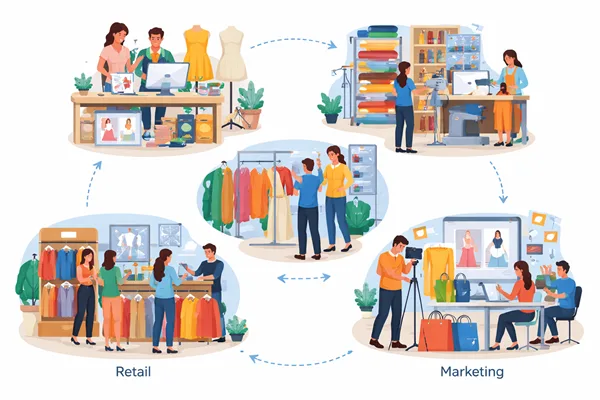
What is Apparel Merchandising?
Nowadays, a dream job is to be an apparel merchandiser. So the question is, what is Apparel Merchandising? Apparel merchandising refers to the techniques used to sell products to consumers. It directly relates to negotiating with existing orders, Buying & Selling goods through maintaining liaison among Buyers, suppliers, as well as factory Management. To be an apparel merchandiser to work in a garments manufacturing factory or a buying house, it’s all about getting a job in merchandising with all the necessary skills. A merchandiser is involved in costing, order getting, shipment, and the payment process. A merchandiser should have knowledge of costing, pricing, negotiation, booking, sampling development, and a good knowledge of textiles, especially fabrics.
Apparel Merchandising Process
Without merchandising, a department/section cannot think about the garment industry or a buying house, a team to communicate with the supplier and customer. In the garment and textile industry, the merchandising team has been playing a vital role in making, executing, and closing export orders. This project aims to know the sequence of Merchandising as much as practice and to know the duties of Merchandiser, such as price negotiation with a buyer, swatch making, follow up on production, quality report, arrange a final inspection, shipment, and commercial activities. The function of merchandising as a working procedure, shipping terms, commercial invoice, letter of credit, qualification of merchandising, and so other things like consumption, costing, accessories, care instructions, etc.
Simply, we can say that the person who is doing the apparel merchandising process is called a merchandiser. We can define an apparel merchandiser as, Apparel Merchandiser is the person who engages himself in sourcing, costing, organizing, arranging, and promoting the sales volume of any commodities in the apparel sector. It can also be said that the person who sells products or merchandise abroad he/she may be called a merchandiser. A merchandiser is a responsible person to fulfill the requirements of the buyer and is also responsible for supplying the required product in due time and adequate quantities. The merchandiser is the bridge between the buyer and the manufacturer, providing the right products with on-time delivery based on the Time and Action Plan, on-time materials sourcing, enabling a company to match the latest market trends of a product, and meet the market and customer demand. As per the merchandising
Concept, time management is a key to succeeding in managing one’s time properly, so one can focus on value-adding actions. Merchandising is an important work in the RMG sector. Without merchandisers, no garment industry can run smoothly, and without Buyers, no garment industry can exist. For this reason, buyer satisfaction is very important. The buyer who comes tour country and buys products from our garment industry. At this time of giving an order, if the buyer is satisfied with the help of the merchandiser or management, then the buyer will come again to place an order. Buyers’ other condition is to deliver the product on time. Merchandiser takes care of this condition seriously because if buyers don’t get the product in a timely manner, then they will not come again to that garment industry.
So merchandisers are handling and caring for all kinds of work, taking orders to ship the product, and always want to satisfy the buyer because the garment industry depends on the buyer’s satisfaction. Recording all the data and documents is essential for every merchandiser. After shipment of the garments, the “Merchandiser” should keep all the documents on the safe side because all the related papers given by the buyer are valuable and necessary. If the buyer wants to repeat the order, then the merchandiser has to follow the previous instruction. So a good, efficient, smart merchandiser has to keep all the data and documents for future business development and orders. If a merchandiser doesn’t keep the previous records or documents, then he/she has to suffer and be required to request the documents again, and that may be a bad impression on the buyer. This will not be good for a good merchandiser. Recording all the data and documents is essential for every merchandiser.
Apparel Merchandising Process Organogram of Factory
Merchandising Director
Merchandising Manager
Assistant Manager
Senior Merchandiser
Merchandiser
Assistant Merchandiser
Trainee Merchandiser
Product Package Terms: Name of Buyer.Order Quantity.Delivery Date. Size and Color Breakdown. Fabric GSM (Specifying percentages)Knitting pattern Fabric GSM Measurement sheet with pictorial description Stitching detail Details of Folding and Finishing Accessories Details of printing Details of washing.
Order execution: Buyer SearchingTech-pack Received Photograph of the style.Style name and number, Fabric details, Trims and accessories details.Graded spec/PAF Construction details.Washing method
Consumption: The familiar formula for consumption is used to have the consumption of different parts of garments. The formula is:(Length + Allowance) * (Width + Allowance) *Number of Parts /Fabric Cut able Width /36 *Number of Garments+ Wastage in Percent (%) = Results in Yards. There is a system of fabric consumption in SGL with the regular marker which is mentioned below:
Costing & Pricing Fabric is the biggest component of any garment costing. Merchandiser takes formal commitments from fabric suppliers while taking price quotes regarding finished width of fabric, shrinkage, elongation, etc. Group provides all trims and accessories price giving by buyer. Buyer communicates directly with suppliers to give the price. By adding washing cost, test cost, CM of garments, buying house commission merchandiser prepares the price of the garment. Standard Group performs the CM costing by doing the costing system of SMS (Standard Minute Value).
Costing & Pricing
Price Offering: A buyer always gives a target price of the garment and the factory should cope with the price as per as possible.
Negotiation: Buyers do not have much time to haggle back and forth and bring down the prices to acceptable levels. Standard Group tries to quote the right price in one shot and to make it accurate.
Buy Chart Received: Buyer ensures the factory by giving a buy chart for confirmation of the order. In buy, chat buyer depicts how many styles he is going to give in one season, the number of garments, the color of garments, and the countries to which the garments will go.
Conclusion
Apparel Merchandising Process is not very complex, but a lot of tasks need to be done for it. Every step is mandatory and useful for the apparel industry. Maintaining correct data and records is the key to success in apparel merchandising.