
Fabric is a material or a sheet of yarn made through the interlacing or interloping process. The fabric that is produced by following the interlacing of two sets of yarn is known as woven fabric, and the fabric that is produced by following the interlocking of one set of yarn is known as knit fabric. Testing is an important part of the fabric. This article is about Fabric Testing Standards, Parameters, and Methods in the Textile Industry.
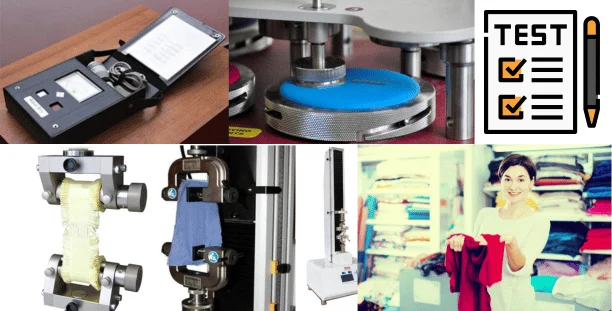
What is a Fabric Test?
Fabric is the main element of garments. There are many quality parameters of fabrics that must be tested to ensure the quality meets the customer’s requirements. Fabric Testing Standards and Methods are defined by the customer. Fabrics become cloth when we cut and sew them according to the human body shape. Fabric’s quality affects the human body directly. Every test follows one standard or method; what are the fabric testing standards or methods?
Objectives of Fabric Testing:
- To check that the fabric conforms to the fabric specification.
- To check the effect of physical and chemical treatment.
- To improve the quality of the products.
- To meet customers’ needs.
- Research and developed a purpose
Fabrics Testing Equipment/ Instruments
| Sl No | Test Parameter name | Instrument |
| 01 | Yarn Count | Electric balance, Counter pin, magnifying glass. |
| 02 | Fabric GSM testing | GSM cutter, specimen fabric. |
| 03 | Fabric fire testing | Gaslighter and fabric. |
| 04 | Distortion or Skew Movement | Washing machine, Measurement scale. |
| 05 | Dimensional stability to washing | Measurement Scale, Washing machine, Tumble dryer. |
| 06 | Fabric Allergy Testing | PH meter |
| 07 | Colorfastness test to Crocking | Crock meter. |
| 08 | Color Fastness to Washing | Detergent, Water, Jar, and test specimen |
| 09 | Fabric Damage testing | Tear strength tester. |
| 10 | Colorfastness to light | Xenon Arc light machine |
| 11 | Seam Slippage test | Strength tester machine, Sewing thread, and needle. |
| 12 | Fabric Abrasion Testing | Abrasion tester, Scissor, Electric Balance. |
| 13 | Crease recovery Test | Crease recovery tester |
| 14 | Snapping & Unsnapping Test | Button snap pull tester machine |
| 15 | Fabric Absorbency Test | Fabric, Water. |
| 16 | Width of the Fabric – Cut table | Cutter machine, Table. |
| 17 | Shrinkage Test | Washing machine, Shrinkage test Scale. |
Different Types of Fabric Testing Standards, Parameters, and Methods in the Textile Industry
Following Different Types of Fabric Testing Standards, Parameters, and Methods in the Textile Industry. The fabric testing method and pass tolerance are mentioned against each fabric testing parameter:
Yarn Count:
Fabric is produced by yarn, so first of all, yarn is tested. Yarn Count is a numerical expression of the coarseness or fineness of the yarn. This test is done by following the ASTM D1059/1907 method. Its acceptance limit is ±3%.
Standard Method: ASTM D1059/1907
Pass tolerance: Its acceptance limit is ±3%.
Construction Per Inch ( Thread / Unit Length ):
PPI & EPI are the most common terms in fabric. PPI means pick per inch, and EPI means Ends per inch. The pass tolerance is + 5% to -3 %*. The test follows the ASTM D3775 method.
Standard Method: ASTM D3775
Pass tolerance: The pass tolerance is + 5% to -3 %*
Fabric GSM testing:
GSM means grams per square meter. It is an important property of the fabric. The more GSM the garment has, the lighter the garment’s weight.
GSM Testing Standards Method: ASTM D3776. Pass tolerance: Pass tolerance is set by the customer based on fabric type.
Fabric fire testing
Fabric is manufactured from various types of yarn. A fabric contains cotton, nylon, polyester, wool, etc. After manufacturing the fabric, it needs to be dyed. Some are appropriate for that dye or not due to the thermal resistance. For that reason, this test is done to identify the yarn and to select the temperature. This test follows the ISO-14116 method.
Fabric Testing Method: ISO-14116
Distortion or Skew Movement:
This test method is used as an indication of the propensity of yarns to shift or distort in a fabric. Such distortions are objectionable due to the resulting changes in appearance. This test follows the AATCC 179 method. Pass tolerance for left Max ±3 % and for right Max ±3 %.
Fabric Testing Method: AATCC 179
Pass tolerance: Pass tolerance for left Max ±3 % and for right Max ±3 %.
Dimensional stability to washing after 3 Home laundry dimensions
Stability is the main function to test. After making garments, if the dimensions do not remain the same as before the wash, all the work will go in vain. To keep an accurate dimension, the test is used. The dimension stability test follows the AATCC 135 method. Pass tolerance along lengthwise max 0 to -3% and widthwise max 0 to -5%.
Standard Method: AATCC 135
Pass Tolerance: length-wise max 0 to -3% and width-wise max 0 to -5% .
Fabric Allergy Testing
During Dyeing, many chemicals are used. So the PH value may differ from the standard. When garments are worn on the body, they also directly react with the skin. If the fabric becomes Acidic or Alkali it will be hazardous for human beings. So it needs to check whether the fabric is neutral or not. This test follows the AATCC 81 method and passes tolerance for Acid Range is max 5.5, and for Alkali 6.5
Standard Method: AATCC 81
Pass Tolerance: pass tolerance for Acid Range is max 5.5 and for Alkali 6.5.
Colorfastness to Crocking
Colorfastness means the tendency of a color to bleed from fabric. The crocking machine is used to test colorfastness. By crocking, the colorfastness can be tested in dry and wet conditions. It follows the AATCC 8 method and its pass tolerance for dry, a minimum of 3-4 grades, and for wet, a minimum of 1.5-3.5 grades according to the scale.
Standard Test Method: AATCC 8
Pass Tolerance: For dry, a minimum of 3-4 grades, and for wet, a minimum of 1.5-3.5 grades.
Color Fastness to Washing
Colorfastness to washing means how many colors bleed due to washing. For this test, multitier stripes are used, and the specimen is attached to this stripe. Then evaluate the specimen before and after washing. It follows the AATCC 61 method, and the tolerance on wool is max 3.5
Standard Method: AATCC 61
Pass Tolerance: pass tolerance on wool is max 3.5
Fabric Damage Testing:
Strengthening is another property of the fabric. So, strength is tested by a tear strength tester machine. This test follows the ASTM D1424 method, and its pass tolerance is a maximum of 1.5-2.5lbs both lengthwise and widthwise.
Standard Method: ASTM D1424
Pass Tolerance: maximum 1.5-2.5 lbs both lengthwise and widthwise.
Colorfastness to light
Colorfastness to light means how much color damage or bleed occurs due to light. For this test, a xenon arc lamp is used, which produces high heat. It follows the AATCC 16 method. Its pass tolerance is 2.5.
Standard Method: AATCC 16
Pass Tolerance: Its pass tolerance is 2.5.
Seam Slippage test
Seam slippage is the problem of special fabrics that contain slippery yarn. This test method is used to determine the resistance to slippage of filling yarns over warp yarns, or warp yarns over filling yarns, by using a standard seam. The tolerance load resistance to yarn slippage should be 15 lbs-25 lbs, and it follows the ASTM D434-95 method.
Standard Method: ASTM D434-95
Pass Tolerance: 15 lbs-25lbs
Fabric Abrasion Testing
Due to rubbing with the body, the entangled small fibers on the surface of the fabric create pilling, which makes the appearance of garments very odd. In order to remove such a problem, a pilling resistance test is done. It follows the method of ISO 12945, which needs 3+1/2 hours and 12000 revolutions. The acceptance pill rate is 2-4.
Standard Test Method: ISO 12945
Pass Tolerance: The acceptance rate is 2-4.
Crease recovery Angles
To determine the recovery properties of fabrics by creasing in a loading device for a predetermined time using a weight. For this test, the Crease Recovery Tester is used. The acceptable Crease recovery angle is 75 Deg and it follows the AATCC 66 method.
Standard Method: AATCC 66
Pass Tolerance: The acceptable Crease recovery angle is 75 Deg.
Snapping & Unsnapping – Holding strength test- ( 4 PARTS BUTTON)
The test method helps to determine the force required to disengage the fasteners that are attached to the garments and clothes. It follows the ASTM D4846 method, and its acceptance load is min 1.5kg and max 2.5 kg. A Snap button puller tester is used for this test.
Standard Test Method: ASTM D4846
Pass Tolerance: Its acceptance load is min 1.5kg and max 2.5 kg.
Anti-Bacterial Activity & Efficacy
To keep the safe fabric from Bacterial activity & efficacy, another test is done. For this kind of test, the JISL-1902 method is followed.
Standard Method: JISL-1902
Pass Tolerance: No allowance for bacterial activity.
Fabric Test absorbency
Absorbency is defined as the ability to absorb water in the fabric. This property is a very important factor for making garments according to use. This test follows ASTM D123–01.
Standard Method: ASTM D123–01
Pass Tolerance: Seconds – Before HL 7 and Seconds – After 10 HL 7.
Width of the Fabric – Cuttable:
No Tolerance for minus width. No upper limit
Standard Method: ASTM D3774-18
Pass Tolerance: No Tolerance for minus width.
Shrinkage Test
Shrinkage is a common term in the garment industry. Shrinkage indicates that how much shortage or how much extend after laundry in measurement. It is denoted as shrinkage %. The more the fabric consumption shrinks, the more it increases, as well as costing is higher. Its tolerance is ±3 %. This test is done by the ISO 6330 method.
Standard Method: ISO 6330 method.
Pass Tolerance: tolerance is ±3% (It varies fabric wise )
FAQS on Fabric Testing Standards, Parameters, and Methods in the Textile Industry
- What are fabric testing standards?
There are guidelines (like from ASTM, ISO, or AATCC) that tell manufacturers exactly how to test things like: Strength (will it rip?) Colorfastness (will it fade in the sun or bleed in the wash?) Durability (will it pill or shrink?) Comfort (does it breathe? does it wick sweat?) - What are GSM testing standards?
There is not a single “GSM testing standard,” but rather standard methods to measure it. The most common ones are:
- ISO 3801 (international)
- ASTM D3776 (US)
- DIN 53854 (German)
3. What are the fabric testing parameters?
Fabric Testing Parameters are:
1. Physical & Dimensional
- GSM (weight)
- Fabric width
- Shrinkage (how much it shrinks after washing)
- Tensile strength (pulling force to break)
- Tear strength (force to rip a cut)
2. Durability & Abrasion
- Martindale / Wyzenbeek (rubbing resistance – how many rubs until it pills or wears through)
- Pilling resistance (those little fuzzy balls on sweaters)
3. Color-related
- Colorfastness to Water, washing, light (sun), rubbing (crocking), Color Fastness to Saliva in Fabric, and perspiration
- Shade matching (is this bolt the same color as that bolt?)
4. Comfort & Transmission
- Air permeability (how easily air passes through)
- Moisture wicking (how fast sweat moves)
- Stiffness / drape (how it hangs)
5. Chemical / Safety
- pH level (too acidic or alkaline can irritate skin)
- Formaldehyde content
- Lead / heavy metals (for kids’ wear, especially)
- You may love to read: Textile Lab Testing Equipment List.
- List of all Colorfastness Tests in the ISO Method
- What is Color Fastness Test? Definition, Meaning, and Types
- Textile Testing of Different Stages: Fiber, Yarn, Fabric, and Garments test
- ISO/IEC 17025 Laboratory Accreditation Process in Textile Testing