
Sewing Needle
A needle is a necessary item for any stitching process. We can use a needle to create a hole in all types of fabric, leather, or other materials. Oh! That also adds to carrying the needle filament through the garment. We can also make a needle thread loop. So, two basic models of needles are plumb and crooked. Most often, a plumb one for sewing our clothes, and it’s used almost everywhere; crooked needles are needed on a blind stitching machine. In this article, we are discussing the details of the different parts of a Sewing Machine Needle with Functions.
We cannot think of sewing cloth without a needle. The needle penetrates during the sewing process to stitch with threads. A sewing machine is for the sewing process, but how to do sewing is definitely done with a Needle. A needle has a few parts, and every part has a specific function. There are needles of both big and small sizes available on the market. We can choose it on the basis of what fabric we want to work on. Basically, thickness and objectives are parameters for selecting a needle.
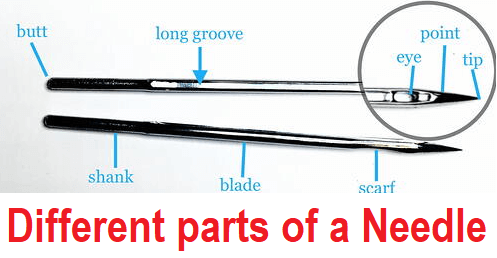
A sewing machine needle is a long, slender tool with a pointed tip that is used for joining different parts of a garment. A needle for hand sewing has a hole, called the eye, and at the non-pointed end carries thread or cord through the fabric after the pointed end pierces it. Hand sewing machine needles have different names depending on the purpose of the sewing machines.
Different Parts of a Sewing Needle
Here are some things that people can easily identify. All sewing machine needles have the same basic parts. Though it’s necessary to discuss all for the sake of the concept, we can add these to the list about Different Parts of a Sewing Needle and their functions:-
Butt– It’s the first part of the bottom edge, and it can hold the needle with the needle bar of the machine. The butt is the thickest part of a needle. This part connects with a sewing machine. The sewing machine holds it tightly for functional work.
Shank– The shank is the largest part of a needle. It can be two types: round and flattened shank. Round is the general; it needs to be fixed by hand to make sure that the scarf is stuck with the hook.
Shoulder– It’s between the butt and the blade. A very strong point to keep the joint between them.
Blade– The blade does most of the work as it’s the largest part of the foreground, and it causes most of the abrasion between the needle and garments.
Scarf– It provides a closer term of the hook to the needle.
Point– It gives a superb introduction to garments according to their characteristics. Normally, there are two types of points available for needles. One is a sharp point, and another is a ball point. When it’s lost sharpness, the needle needs to be replaced.
Tip– The tip is the last edge point of a needle, which is very sharp, and is used to penetrate fabrics. If the tip loses its sharpness, the fabric will have a needle cut. Every Needle has a lifetime, which is maybe 12-14 hours.
Eye– The needle eye is a hole that holds stitching thread during the sewing process; the needle eye passes through a material (fabric) during stitching.
Conclusion
A needle is the main functioning element in the sewing process. No needle, no way of sewing. And each part of a Sewing Needle plays an important role. That is why needle management is very important in the medical industry.